Zomato
- Zomato is an Indian multinational restaurant aggregator and food delivery company.
- It was founded by Deepinder Goyal and Pankaj Chaddah in 2008.
- Zomato provides information, menus and user-reviews of restaurants as well as food delivery options from partner restaurants in more than 1,000 Indian cities and towns, as of 2022–23
- Zomato is an Indian food delivery startup restaurant aggregator. It primarily provides concrete information, menus, and user reviews of the restaurants.
- Along with this, Zomato also has food delivery options from partnered restaurants in the selected cities.
- Zomato has hit a valuation of $5.4 Billion on February 22, 2021, after its recent funding round on the same date led by Kora, Fidelity, Tiger Global Management, and others for $250 Million.
History
- Zomato was founded as FoodieBay in 2008 by Deepinder Goyal and Pankaj Chaddah who worked for Bain & Company
- Bain & Company is an American management consulting company headquartered in Boston, Massachusetts.
- The firm provides advice to public, private, and non-profit organizations. One of the Big Three management consultancies, Bain & Company was founded in 1973 by former Group Vice President of Boston Consulting Group Bill Bain and his colleagues, including Patrick F. Graham
- The website started as a restaurant-listing-and-recommendation portal. They renamed the company Zomato in 2010 as they were unsure if they would "just stick to food" and also to avoid a potential naming conflict with eBay.
- eBay is an American multinational e-commerce company based in San Jose, California, that facilitates consumer-to-consumer and business-to-consumer sales through its website.
- eBay was founded by Pierre Omidyar in 1995 and became a notable success story of the dot-com bubble. eBay is a multibillion-dollar business with operations in about 32 countries, as of 2019
- With the introduction of .xxx domains in 2011, Zomato also launched zomato.xxx, a site dedicated to food porn.
Idea for Zomato
- There were days when we used to call different restaurants to place orders and again call up for corrections directions and reservations.
- Then came applications like Zomato, which reversed the whole scenario and made it extremely simple for consumers. Deepinder Goyal and Pankaj Chaddah founded Zomato in 2008, which eased the process of food delivery and eating out, with the help of which we now can enjoy the best food served by the restaurants in our locality.
Zomato Products and Services
- They started with only a food discovery app. Now they have expanded to various macro sections in the food industry,The list of services given by Zomato,
- Restaurant Ratings & Reviews,
- Restaurant Search & Discovery,
- Online Order: Food Delivery,
- Pick Up: Ordering Take away,
- Table Reservations,
- Hyperpure: Ingredients supply to restaurants,
- Food@Work: Canteens,
- Gold: Restaurant premium subscription services
Zomato Business Model
- Zomato not only earns from the commission from the restaurants, delivery charges, and their membership. That’s not only their overall source of earning money.
- Zomato is continuously experimenting and growing their business and revenue.
- Currently, Zomato earns from in-app advertising, subscription, food delivery service, Zomato Gold. Apart from all these Zomato also organizes Food events and attendees pay a small fee as a ticket.
Online Ordering Service: Zomato takes a certain percentage from the restaurants on each sale done through the Zomato app/website.
In-App Advertising: Advertisement is one of the major contributors to Zomato Revenue. It offers restaurants to buy space or bid on a particular city, on their app and pay for it. It can be a restaurant listing, banners, sliders. It works similar to Google search and display ads
Delivery Charges: Zomato also charges a delivery fee from the users. It may depend upon your order size and the distance between you and the restaurant. It may vary from Rs.0 to Rs.50.
Organizes Events: Zomato also started organising food events with a name “Zomaland“. The sale of event tickets and sponsorships are contributed in their revenue.
Zomato Book And Zomato Gold: These are 2 services that save a lot of time for the users. With Zomato Book you can reserve any number of seats in any restaurants and cafes with a nominal fee. While Zomato Gold gives some additional benefit to the customer with a monthly or yearly fee like buy 1 get 1 on cold drinks, extra discount, free delivery, and much more.
Acquisitions
- Zomato has acquired several startups globally.
- In July 2014, Zomato made its first acquisition by buying MenuMania for an undisclosed sum.
- The company pursued other acquisitions including lunchtime.cz and obedovat.sk for a combined US$3.25 million.
- In September 2014, it acquired Poland-based restaurant search service Gastronauci for an undisclosed sum.
- In December 2014, it acquired Italian restaurant search service Cibando.
- It acquired Seattle-based food portal, Urbanspoon, for an estimated US$60 million in 2015.
- Other acquisitions of 2015 include Mekanist in an all-cash deal,the Delhi-based startup MapleGraph that built MaplePOS (renamed Zomato Base), and NexTable, a US-based table reservation and restaurant management platform.
- In 2016, Zomato acquired Gurgaon-based technology startup Sparse Labs and renamed it as Zomato Trace.
- In 2017, it acquired the food delivery startup Runnr (renamed from Roadrunnr when it acquired TinyOwl in 2016).
- In September 2018, it acquired Bengaluru-based food e-marketplace, TongueStun Food, for about US$18 million in a cash and stock deal.
- In December 2018, it acquired a Lucknow-based startup, TechEagle Innovations, that works exclusively on drones, for an undisclosed amount.
- Zomato claimed that the acquisition will help pave the way towards drone-based food delivery in India, building technology aimed at a hub-to-hub delivery network.
- On 21 January 2020, Zomato acquired its rival Uber Eats' business in India in an all stock deal, giving Uber Eats 10% of the combined business.
- On 29 June 2021, the firm acquired a 9.3% stake in Grofers for nearly US$120 million.
- On 24 June 2022, Zomato acquired Blinkit (formerly Grofers) for US$568 million in an all-stock deal.
Zomato - Founders & Team
The founders of Zomato are Deepinder Goyal and Pankaj Chaddah. Both are IIT graduates and were working with Bain & Co. in New Delhi before they came together to launch Zomato.
Deepinder Goyal
- Deepinder Goyal is an IIT Delhi alumnus. Goyal was not a good student back at school but he eventually made his way to the prestigious IIT.
- After completing his graduation, Goyal was hired by Bain and Company, where he served as a Senior Associate Consultant for a little less than 4 years, after which he founded Zomato.
- Deepinder Goyal has waived his salary for FY22. This was disclosed in a regulatory filing of Zomato dated June 7, 2022.
Pankaj Chaddah
- Pankaj Chaddah is a BTech, Mechanical Engineering graduate from IIT Delhi.
- Chaddah completed his graduation and then went to join Bain and Company, where he served for two and half years before joining Deepinder to found Zomato.
- However, this co-founder resigned from Zomato in May 2018, where he served as a "conscience keeper, and a support system during upheavals," as he had described his role, for over 10 years.
- Chaddah founded Shyft (formerly Mindhouse) in November 2019, where he currently serves as a Co-founder.
- Aakriti Chopra, one of the early employees of Zomato, has been promoted to the Co-founder position.
- She worked as the Chief People Officer when the promotion landed to recognise her contributions to the company.
- Aakriti Chopra is the wife of Albinder Dhindsa, the chief of Blinkit, and her promotion came in on June 9, 2022, with the signalling of the companies coming closer.
- So now, the revelation is somewhat interesting that the Zomato Co-founder, Aakriti Chopra is married to the Founder of Blinkit, Albinder Dhindsa.
- Gaurav Gupta, who initially joined as the Global Head of the Advertising sales of Zomato and COO and was later promoted to the Co-founder position of the platform, resigned on September 14, 2021.
- Gaurav headed the supply of the food-tech company.
- Zomato has been shutting down some of its business lines and subsidiaries, including its grocery delivery service, nutrition and nutraceuticals, and a bunch of its international subsidiaries since the company went public in July.
- Gaurav Gupta's resignation starkly followed the decision of the company for taking down its grocery delivery and nutraceutical services.
- On his parting, Gaurav Gupta had drafted a beautiful mail that he sent to everyone at Zomato with a special address to Deepinder Goyal.
- Zomato CEO, Deepinder Goyal had not failed to reply to the touching mail.
- The Zomato recruiting team is of the ideology that hiring the correct people is primary for their company's startling growth.
- Also, recruiting this pool of employees was one of the major milestones achieved while building the foundation of Zomato.
- Now, the company has a squad that is vital in bricking their dream project. The Zomato number of employees has been listed between 1001-5000 in numbers as per the Zomato LinkedIn profile.
- The Zomato food delivery business is not the sole business of Zomato. It now has numerous businesses working under the same label and would allegedly get a new parent "Entity".
- While Deepinder Goyal is the CEO of Zomato, the other arms of the business like Blinkit and Hyperpure are led by Albinder Dhindsa and Vishal Kumar. Mohit Gupta leads the food business of Zomato.
About Zomato Timeline
Present
- Acquires UBER Eats Introduces Contact-less Dining
2019
- Launches Zomaland
- Introduces Videos on its Platform
2018
- Launches Hyperpure and Food@work
- Acquires Tonguestan Food Network Pvt Ltd, TechEagle
2015-2017
- Launches Food Delivery Introduces Membership Program "Zomato Gold"
- Acquires Urbanspoon, Mekanist, Nextable etc
2012-2014
- Goes International with UEA Launch
- Acquires MenuMania, Lunchtime, Cibando, Obedevat, Gastroanuci.pl
2008-2010
- Founded as Foodiebay.
- Raises Angel Investment and Rebrands as Zomato
Zomato - Startup Launch
- When the founders launched this website, it wasn’t called Zomato back then, it was called Foodiebay.
- And it initially started out in Delhi, then the services were extended to cities like Mumbai and Kolkata.
- With the tremendous user base and growth rates that Foodiebay brought in to the founders, they decided to modify it and take it international.
- That’s when this venture started being called Zomato, as we know it today. It was in 2010 when Foodiebay was officially rechristened as Zomato.
Zomato - Mission and Vision
- Zomato states that their mission "is to ensure nobody has a bad meal."
- Zomato co-founder Pankaj Chaddah had declared that the vision of Zomato "is to be the global platform when someone is looking for food locally."
- Zomato - Name, Tagline, and Logo
- The founders changed Foodiebay to 'Zomato' to make it more prominent, simple to memorize, and primarily to eliminate the confusion with the website eBay.
- Zomato's tagline is "Never have a bad meal".
Zomato - Business Model and Revenue Model
- The main source of revenue for Zomato now is the advertisements channel that the portal offers to display.
- This accounts for most of its revenue followed by the commissions that it charges to the restaurants. It works on a commission business model.
- Zomato announced that it will do away with commissions it charges restaurant partners on takeaway orders.
- In a bid to help them recover faster from the economic crisis that the Covid-19 pandemic brought in, Zomato made the announcement, which also offered customers an alternative to Zomato delivery service or home delivery.
Zomato - Future Plans
- Zomato is currently looking to focus on its Indian food delivery business as of now after closing most of its international businesses.
- Zomato is forecasted to grow at a CAGR of 40%.
- Deepinder Goyal is hopeful of figuring out the best possible way of delivering food in 10 minutes and leveraging the same to grow.
- Zomato Instant is currently piloting only one location, as of May 24, 2022.
- Food and quick commerce are the main focuses of Zomato, as of now.
- “If the pilot is successful and we decide to scale it beyond the current handful of locations, then there will be capex needed to set-up the food finishing stations. But that will only happen once we have confidence that the payback period for the capex will be attractive,” said Goyal.
- Zomato chief Deepinder Goyal mentioned that the company will be profitable, but didn't mention any timeline, saying that Zomato is not keeping profitability aside, but is taking the same with the growth initiatives.
- Goyal mentions that it won't be tough for Zomato to have more than 7 million transacting users every year, in the next decade.
- Also, Zomato is planning to appoint four CEOs to run different units of the business and rebrand itself as Eternal Ltd. in the near future.
- Goyal, the co-founder and CEO of the company has shared an internal memo with the employees that read, “We are transitioning from a company where I was the CEO to a place where we will have multiple CEOs running each of our businesses (e.g. Zomato, Blinkit, Hyperpure, Feeding India), all acting as peers to each other, and working as a super-team with each other towards building a single large and seamless organisation. Starting today, we are going to call this larger organisation “Eternal,” Deepinder said, adding that it will remain an internal name for the time being.
- The company will be using the new name, Eternal for its workspaces and emails. Goyal said that he foresees a day when the instant grocery overtakes its food delivery business.
- At that time, “we will change our company’s name from Zomato Ltd. to Eternal Ltd., and also change our stock ticker to ETERNAL,” he further added in the note.
- The idea's development is still in the initial stage and Zomato has not yet made an official announcement regarding the rebranding.
Zomato - Partnerships
- Being active since 2008, Zomato has also seen a lot of partnerships with a diverse range of national and international companies including restaurants, cafes, fintech companies, and more.
- Zomato has partnered with the government of India for a street food project on February 5, 2021
- Zomato joined hands with InCred to extend credit facilities to restaurant partners on December 21, 2020
- Zomato collaborated with RBL Bank on March 2, 2020, to launch the "Edition Credit card" powered by Mastercard
- Zomato and BioD Energy had collaborated to reduce the wastage of cooking oil in the country on October 21, 2019
- The company partnered with Paytm to expand its food ordering business online in India on January 18, 2019
Zomato - Competitors
- Though Zomato is very predominantly present in the industry, it does face a lot of direct and indirect competition. Zomato faces direct competition from Swiggy, and competition from other players, including:
- Faasos
- Box8
- Domino's
- FreshMenu
- Pizza Hut
- TravelKhana
Some of the other international competitors of Zomato are:
- DoorDash
- Uber Eats
- Grubhub Inc.
- Deliveroo
- Postmates
- ChowNow
Zomato - Awards and Achievements
- Zomato won a range of prestigious awards throughout the years. The food tech giant even bagged the top honours at the seventh edition of The Economic Times Startup Awards, including the Startup of the Year award in 2021.
Zomato - Growth and Revenue
- Zomato has grown far and wide ever since it brought in the disruptive idea of food delivery in the Indian ecosystem of startups.
- As part of its new growth initiative, the company is looking to come up with ultra-fast food deliveries for which Zomato is in talks with restaurant partners and cloud kitchens.
- As per this new initiative announced on March 18, 2022, Zomato will be launching a faster food delivery service that will deliver food within 10 minutes of ordering.
- Zomato has already tried this experiment briefly in Bengaluru in 2021 and might pilot this in some cities in the coming April 2022.
- Zomato Co-founder and CEO, Deepinder Goyal has mentioned that Zomato is racing towards profitability, and at the same time, keeping growth in mind.
- Furthermore, it is also looking to protect the long-term view of how the Zomato business would look in the next 10-20 years from now.
- Goyal said, “even our largest cities like Delhi are growing as fast as the smallest towns. Every small area within Delhi is equal to a small town. The penetration is going up, and the frequency at which customers order is going up.”
- Zomato now has 3 different brands in operation - Zomato, Blinkit, and Hyperpure.
- This is a reason why Zomato now needs a parent entity, as per Zomato chief Deepinder's words. This entity would allegedly be named "Eternal", as of August 1, 2022.
- Zomato's food delivery business, Blinkit, Hyperpure, and Feeding India will likely be a part of the "Eternal" umbrella.
- The Zomato parent would also reveal a new logo soon.
Swiggy Commisions
- New partners to Zomato can receive 0% commission with Swiggy Launchpad.
- On average, Zomato platform has over 2.5 lakh restaurant partners active, and on average, 10,000 eateries are added each month.
- Up until the first month, this promotion is valid for all partners who are new to the Zomato platform.There is no charge for the commission.
- For each order placed through its platform, Zomato charges eateries 15% to 20%.
- You are required to pay a commission on the sales they bring in for your restaurant.
- The standard commission rate is 15–22% plus GST. Delivery and payment gateway fees are not included.
- Lately They charge restaurants commissions or fees that range from 22% to 28% in order to make money. Due of the high commission, a delivery menu was introduced.
Zomato's Shares Rise
- As soon as Zomato declared its Q4 results in FY22 on May 23, 2022, the food tech unicorn's shares showed up as 4% positive the very next day.
- The Zomato shares were on a continuous rise and were trading at Rs 67.05 at 9:38 am on May 24, 2022.
- The Zomato shares rose nearly 14% on the BSE on May 24, 2022, and settled 13.65% higher at Rs 64.95.
- The shares of Zomato went up by 3% to become Rs 56.20 during intraday trading on August 8, 2022, on BSE.
- This happened after FTSE found it fit to increase the investability weight of the foodtech unicorn's stocks.
Zomato's growth highlights:
- By 2011, Zomato had successfully established a monopoly in Delhi NCR and had moved to other Indian cities like Pune, Bangalore, Chennai, Hyderabad, and Ahmedabad.
- Zomato also kept up with the smartphone boom and timely launched its mobile application. This greatly contributed to its growth.
- By 2012, Zomato had begun its overseas operations, full-fledged in countries like UAE, Sri Lanka, Qatar, United Kingdom, Philippines, and South Africa.
- In 2013, it added Turkey, Brazil, and New Zealand to its ever-growing list of expansions.
- In 2017, Zomato claimed that it was operating profitably in all 24 countries along with rolling out a zero-commission model.
- The company claimed that its revenue grew by 81% in this particular year.
- In the same year, the online ordering services of the company crossed the mega milestone of 3 million orders per month.
- Zomato proudly boasts of serving 1.5+ million orders in a day
- If we look at the numbers, Zomato has recorded a 225% rise in revenue in the first half of Financial Year 2020.
- Zomato delivered its 1 billionth order in July 2021.
- In an unprecedented order spike during New Year's eve, food delivery giant Zomato recorded delivering over 2.5 mn orders packing in 7100+ orders per minute.
- The Deepinder Goyal-led food delivery unicorn reported delivering 4250 orders per minute during the same time in 2020.
- Zomato launched Zomato Wings, a platform that is designed to connect investors with the restaurants. “We hope to build the go-to platform for venture capital firms, angel investors, family offices, etc. that are looking to make private investments in restaurants and cloud kitchens,” Zomato CEO Deepinder Goyal mentioned in a blog. However, Goyal has already made it clear that Zomato would only be a facilitator of fundraising for the restaurants and will not be investing in any of its partner restaurants.
- Zomato Launches AI-Powered Food Discovery
- In a recent statement, Zomato introduced its cutting-edge innovation, Zomato AI, a revolutionary AI-powered food discovery companion.
- This advanced feature, seamlessly integrated into the latest version of the platform application, aims to redefine the way users interact with food-related services.
- Zomato AI is specifically crafted to understand and cater to individual preferences, dietary requirements, and even moods, providing a level of personalization and convenience that transcends the capabilities of traditional chatbots
- . With its promise of culinary delight, Zomato AI represents a significant leap forward in the world of food technology and underscores the company's commitment to pushing the boundaries of what AI can achieve in enhancing the dining experience.
- Craving a specific dish? Zomato AI will present you with a widget, listing all the restaurants serving your desired dish.
- Unsure about what to order? No problem! Zomato AI can suggest a list of popular dishes or restaurants, taking the guesswork out of your meal selection,” Zomato stated
- The company expressed confidence in the capabilities of Zomato AI, highlighting its proficiency in managing intricate queries. According to the company's statement, the AI system is well-equipped to tackle challenging questions such as "What should I eat when I'm hungover?" and "Can I find something high in protein and low in carbohydrates?"
- This declaration underscores the AI's versatility and its ability to provide thoughtful and tailored responses to a wide range of culinary inquiries, enhancing the overall user experience.
Zomato Future Foundation
- Zomato Future Foundation will be designed as a Zomato entity that will cover the costs of education of up to 2 children of all the Zomato delivery partners.
- The total costs covered by Zomato Future Foundation would be Rs 50,000 per child per annum on actuals.
- However, the particular employee who will be able to avail of such a benefit will have to exhibit a quality performance that should be over a certain benchmark and has to be associated with Zomato for 5+ years.
- Once the employee crosses the 10-year mark in his service in Zomato, the amount of the education expenses covered by the company will become Rs 1,00,000 per child per annum.
- Furthermore, Zomato will also provide scholarships for higher education over and above these limits for children who will be exceptional in their performance and potential.
Zomato - Hyperpure
- Hyperpure by Zomato is changing the way restaurants work. It is Zomato’s B2B food tech vertical.
- Hyperpure allows restaurants to buy everything online from vegetables, fruits, poultry, groceries, meats, and seafood to dairy and beverages.
- It claims to be working directly with farmers, mills, producers, and processors to source these products thus ensuring quality and consistency
- It is an initiative by Zomato to provide fresh, hygienic, high-quality ingredients and supplies.
Zomato Pro Plus Loyalty Membership
- Zomato Pro Plus Loyalty Membership is a subscription-based service offered by Zomato, which benefits the users who dine out or order food often with amazing offers and discounts.
- This service has paused the intake of new subscriptions in May 2022. According to the reports dated July 23, 2022, the food delivery company is working in-house to help the membership to be more dine-in friendly.
- The earlier version, as per some, has not taken off successfully because of its inclination to offer more benefits in takeaways/deliveries, and a departure from the dine-in service benefits.
- However, with more and more people interested in having food at restaurants after the receding of the coronavirus pandemic, this service would now be focused more on dine-in experiences.
Zomato - Zomato Payments
- Zomato announced the incorporation of a new subsidiary, Zomato Payments Private Limited, which will be wholly owned by the company.
- While filing, Zomato disclosed that it has incorporated the subsidiary with a subscription of 10,000 equity shares of Rs 10 each aggregating to Rs 1,00,000.
- The Indian food delivery giant is looking to work as a payment aggregator and offer payment gateway services, as per the RBI guidelines with its freshly incorporated subsidiary.
- The all-new Zomato payments will serve as a payment and settlement system, along with offering payment gateway services, and will also act as a payment solution for paying goods, services, and utility bills with the help of mobile phones.
Zomato – Zomaland
- Zomaland is India's Grandest Food and Entertainment Carnival that brings together some of the top eateries, musicians, DJs, comedians, and interactive installations and carnival games, under one roof.
- It is like the offline version of its Zomato Collections, where it curates and brings the best restaurants in the city together.
- It is a flagship event of Zomato. In 2018, The debut edition of this carnival across Delhi, Bengaluru, and Mumbai saw over 100,000 visitors.
- Since then it has grown to be held in over 10 cities and has also partnered with major brands including the Singapore Tourism Board.
Features
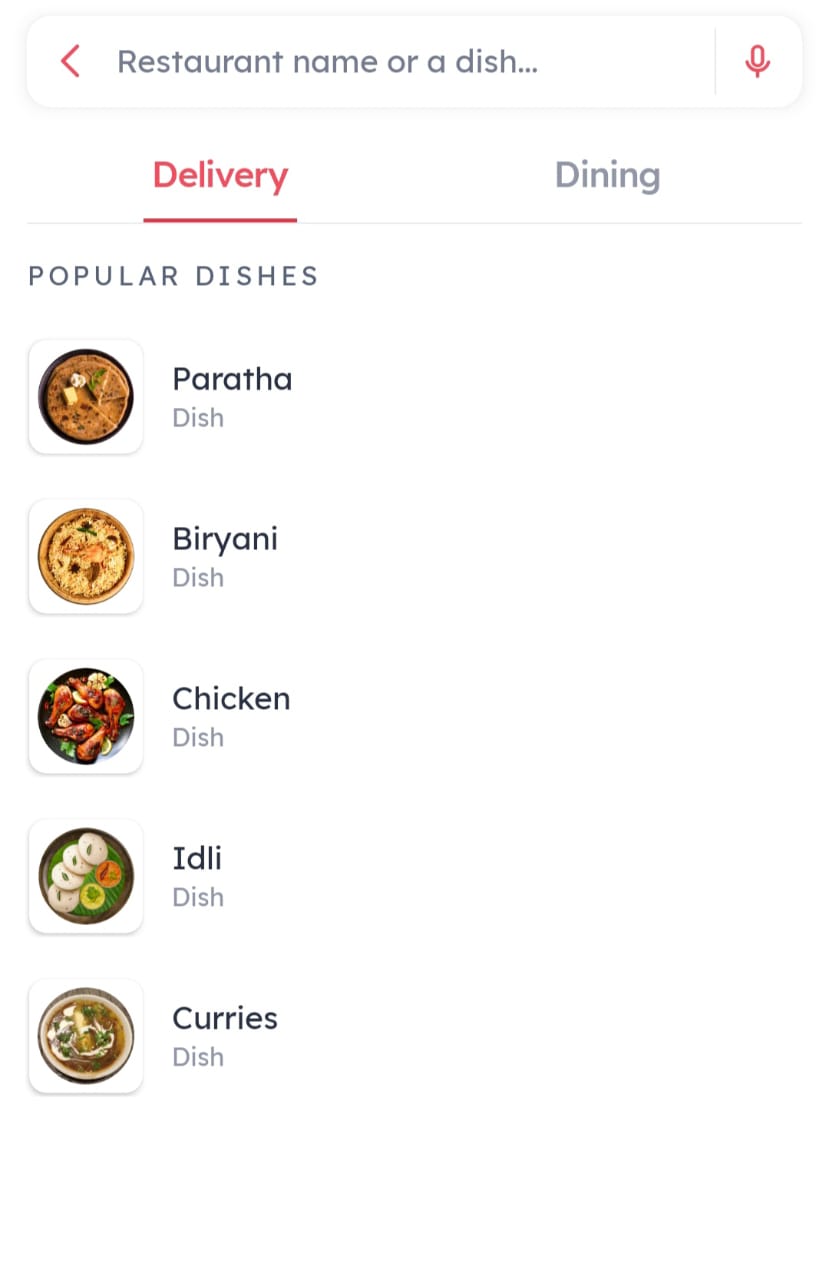
- Restaurant Discovery: Users can search for restaurants based on location, cuisine, or specific dishes. They can read restaurant reviews and ratings from other users.
- Food Ordering: Users can browse menus, place food orders for delivery, or for pickup from restaurants nearby.
- User Reviews and Ratings: Zomato allows users to leave reviews and ratings for restaurants they have visited, helping others make informed decisions.
- Photos and Menus: Users can view photos of the restaurant's ambiance, dishes, and menus to get a better idea of what to expect.
- Search Filters: Zomato provides filters for users to narrow down their restaurant search based on factors like cost, type of cuisine, opening hours, and more.
- Order Tracking: Once an order is placed, users can track its status in real-time, from preparation to delivery.
- Secure Payments: Users can make secure online payments for their food orders using various payment methods, including credit/debit cards, digital wallets, and more.
- Table Reservations: Zomato may offer the ability to reserve tables at restaurants in advance.
- Deals and Discounts: Users can find special offers, discounts, and promotions from restaurants in their area.
- User Profile: Users can create profiles to save their favorite restaurants, write reviews, and keep track of their order history.
- Delivery Tracking: Zomato provides real-time tracking of the delivery person's location for food orders.
- In-App Chat Support: Some versions of the app may include a chat support feature to assist users with their orders or address any issues.
- Zomato Gold: This is a subscription service that offers benefits like discounts at partner restaurants and exclusive access to events.
- Zomato Pro: Another subscription service that provides benefits like complimentary dishes, faster delivery, and more.
- Food Blog and Articles: Users can read food-related blogs and articles, including restaurant recommendations and culinary trends.
Delivery
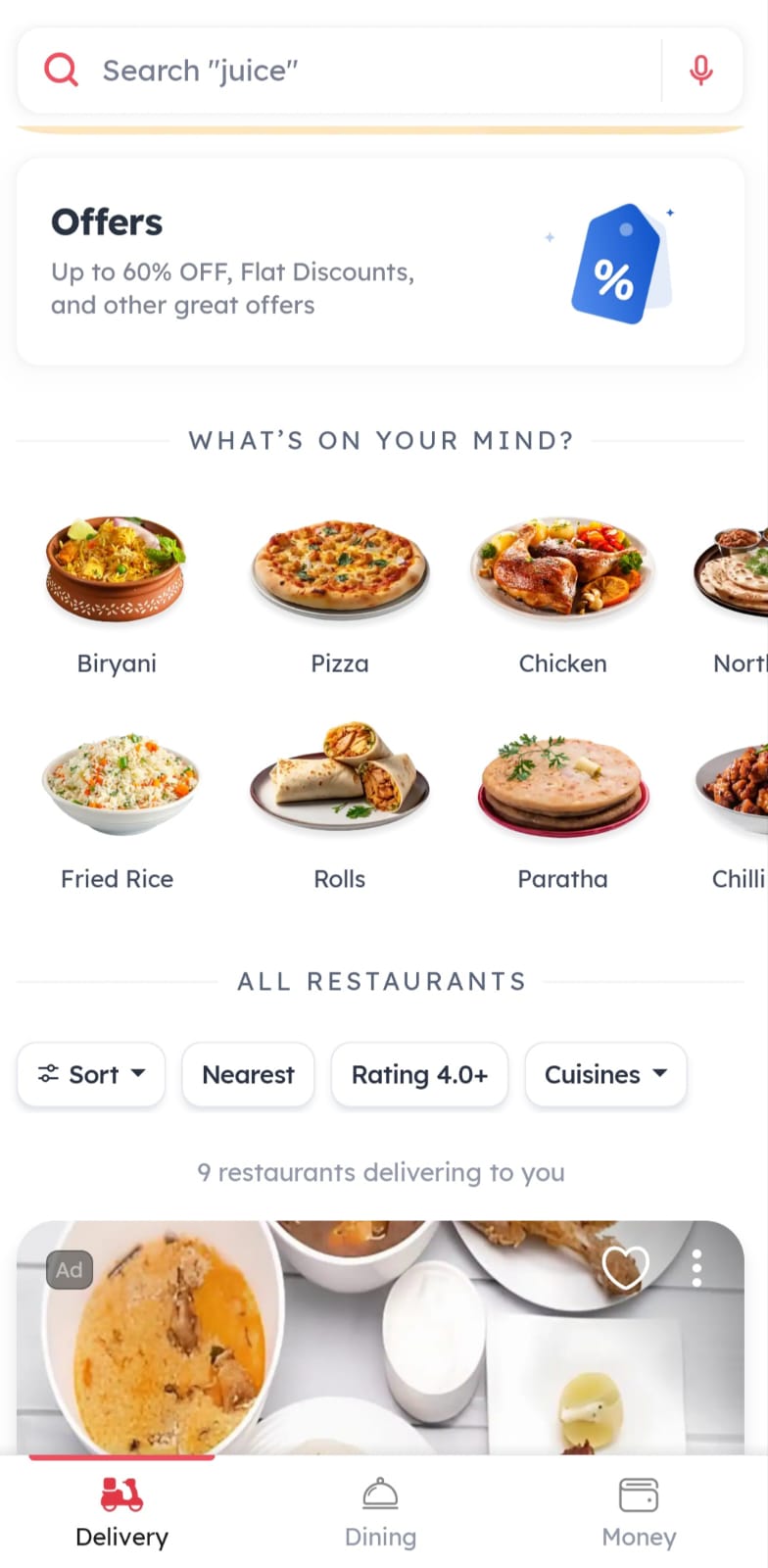
1. Food Items (Menu): This section displays a list of food items available for delivery from various restaurants. Each item typically includes a name, description, price, and possibly a photo. Users can scroll through the menu to browse available dishes.
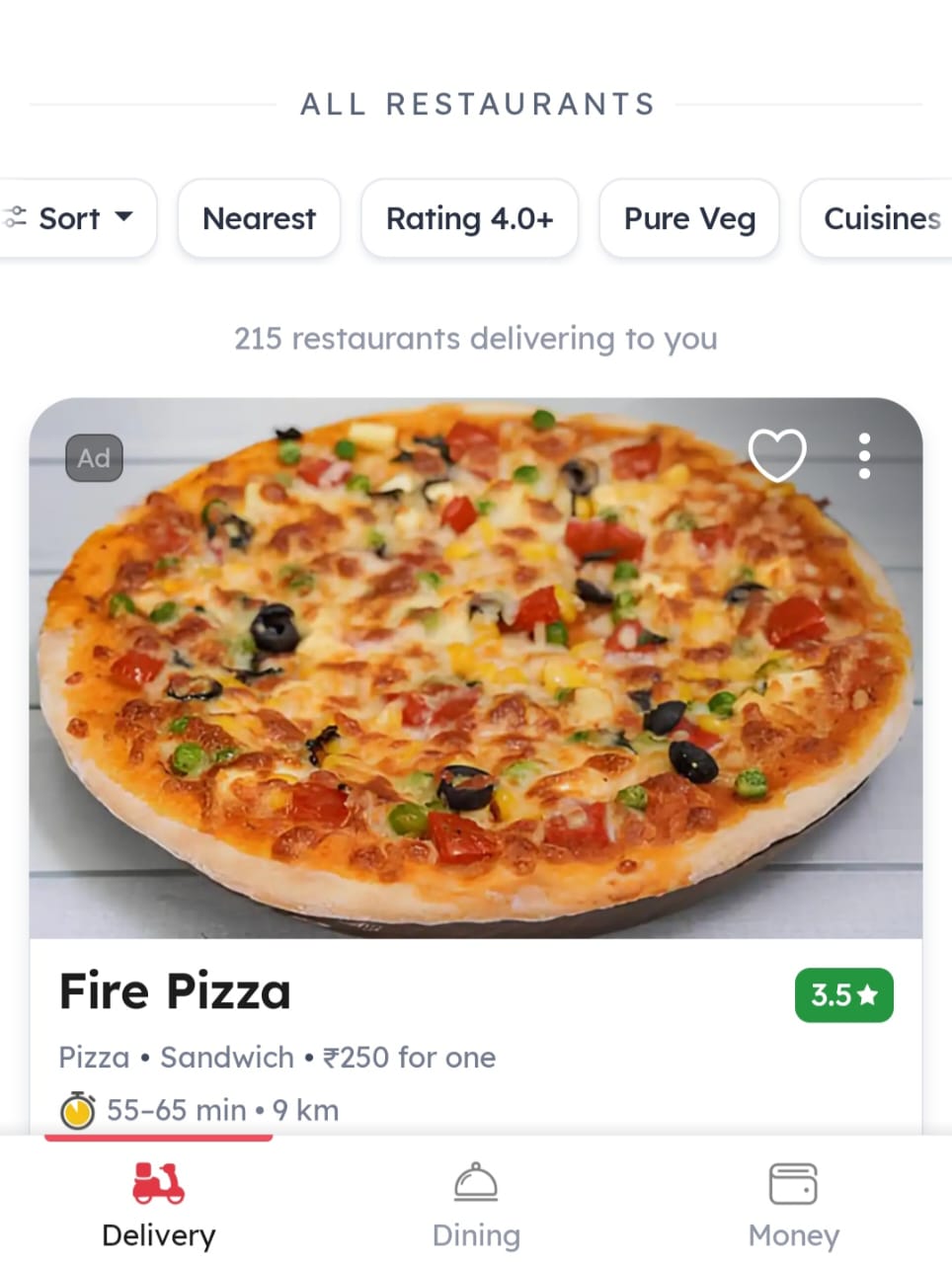
2. Restaurants: The app may allow users to filter or sort food items by restaurant. You can select a specific restaurant to see only its menu items or explore different options from multiple restaurants.
3. Filters: Filters help users narrow down their food choices. Common filters may include cuisine type (e.g., Italian, Chinese), dietary preferences (e.g., vegetarian, vegan), price range, and more. Users can apply these filters to refine their search results.
4. Offers and Discounts:The app often displays special offers, discounts, or promotions available for specific restaurants or food items. Users can view these offers to potentially save money on their orders.
5. Delivery Time:The estimated delivery time is usually displayed for each restaurant or food item. This provides users with an idea of how long it will take for their order to be delivered to their location. Keep in mind that delivery times may vary depending on factors like distance and restaurant preparation time.
6. Add to Cart: Users can add food items to their cart by selecting the items they want to order. The cart typically displays the list of selected items, their quantities, and the total cost.
 7. Checkout and Payment: Once users have added items to their cart, they can proceed to the checkout page. Here, they can review their order, provide delivery information (address), and choose a payment method (e.g., credit card, digital wallet) to complete the transaction.
8. Delivery Tracking: After placing an order, users may have the option to track the delivery in real-time. This feature provides updates on the status of the order, including when it's being prepared, picked up by the delivery person, and the estimated time of arrival.
9. Order Summary: Users can typically view an order summary that includes the list of items ordered, their prices, taxes, delivery fees, and the total cost. This summary helps users confirm their order details before finalizing the purchase.
10. **Order History:** Some apps provide access to the user's order history, allowing them to review past orders, reorder favorite items, and track previous deliveries.
Dining
1. Restaurant Discovery: Users can explore a curated list of restaurants that offer dine-in services. These restaurants would have physical dining spaces for customers to enjoy their meals.
2. Filters: Filters allow users to refine their search for dine-in restaurants based on specific criteria. Common filters might include:
- Cuisine Type: Users can select their preferred cuisine, such as Italian, Indian, Chinese, etc.
- Location: Users can specify the area or neighborhood where they want to dine.
- Price Range: Filters based on price can help users find restaurants that match their budget.
- Rating: Users may be able to filter restaurants based on user ratings and reviews.
- Availability: A "Book a Table" filter would allow users to see only those restaurants where they can make reservations.
3. Restaurant Details: When users click on a restaurant, they can access more information about it. This might include:
- Menu: A list of dishes available for dining in, along with their descriptions and prices.
- Photos: Images of the restaurant's interior, ambiance, and dishes.
- Ratings and Reviews: User-generated ratings and reviews to help users make informed decisions.
- Location: Address and map to help users find the restaurant.
4. Book a Table: This feature would allow users to reserve a table at the selected restaurant. Users can choose the date and time for their reservation, specify the number of guests, and complete the booking.
5. Ratings and Reviews: Users can read and leave reviews and ratings for restaurants they have dined at. This helps others in the community make informed choices about where to dine.
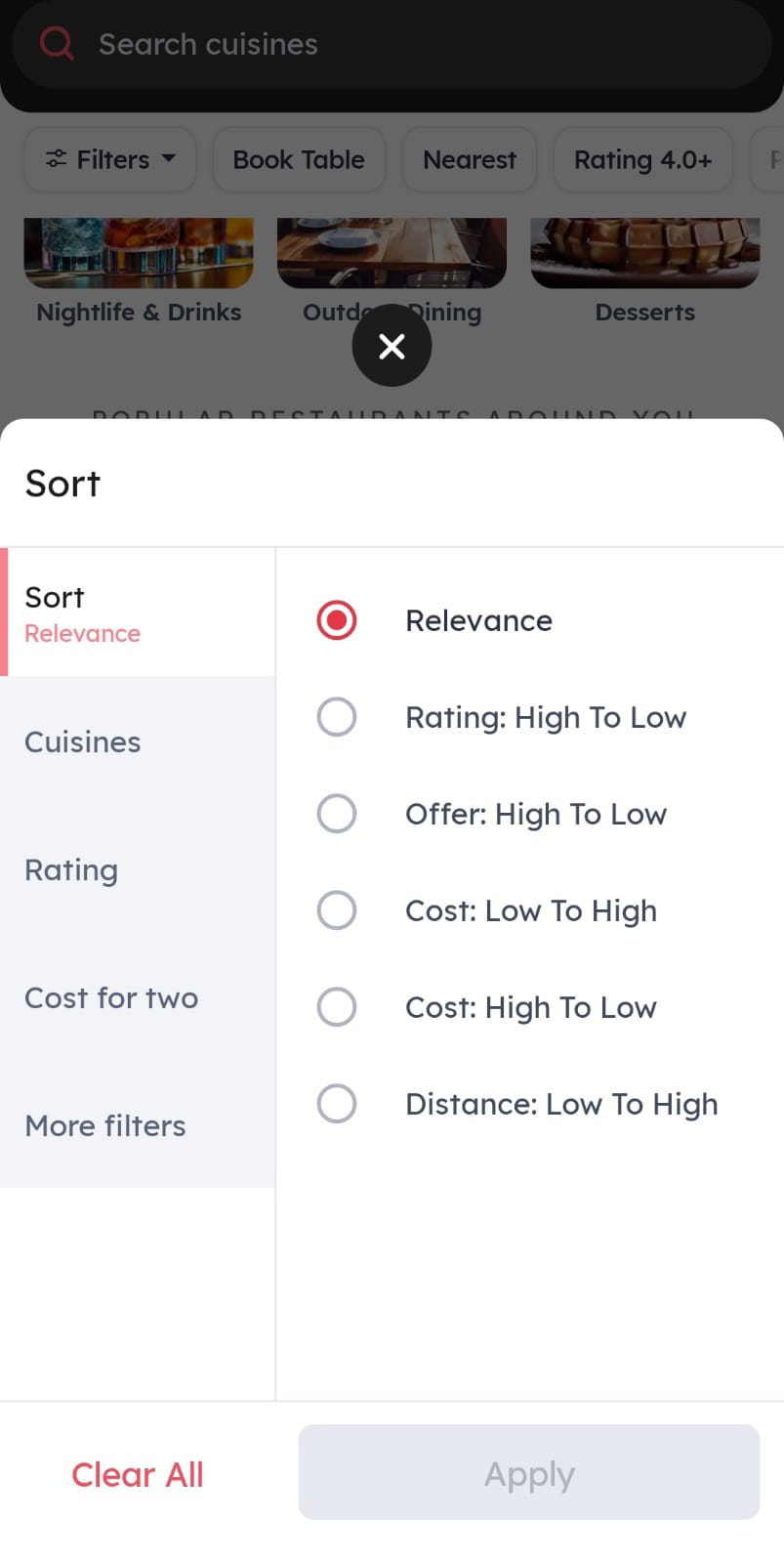
6. Offers and Discounts:The app might display special offers, discounts, or promotions available for dine-in at specific restaurants.
7. Table Reservation Confirmation: After booking a table, users would receive a confirmation with details of their reservation, including date, time, and restaurant location.
8. Ordering: Some platforms might allow users to place orders for food while dining in, making it convenient to add dishes to their table and track their order status.
9. Dining Experience Tracking: If available, this feature would provide real-time updates on the dining experience, including the status of the reservation, when the table is ready, and any additional information about the restaurant's ambiance.
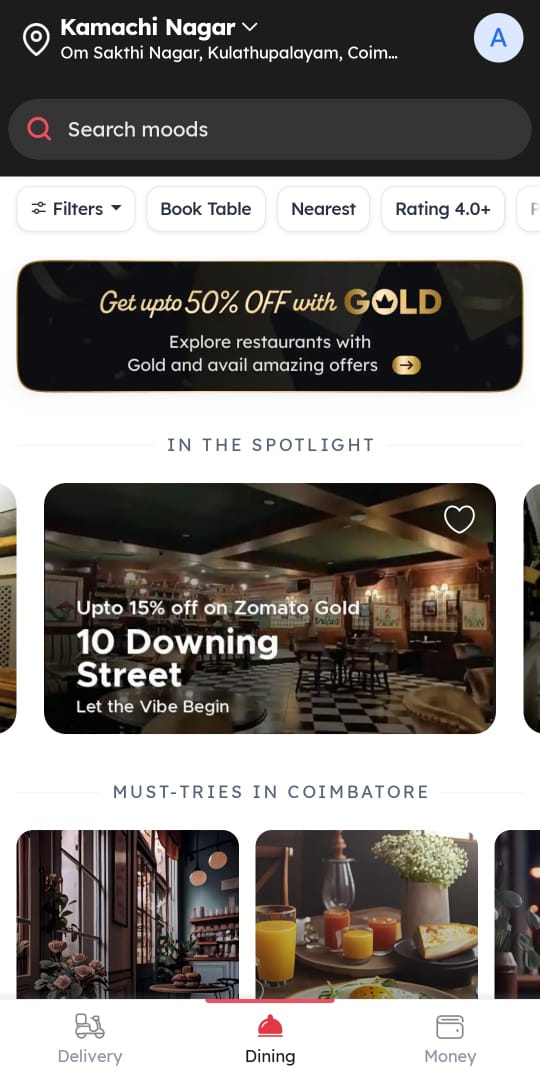
Money
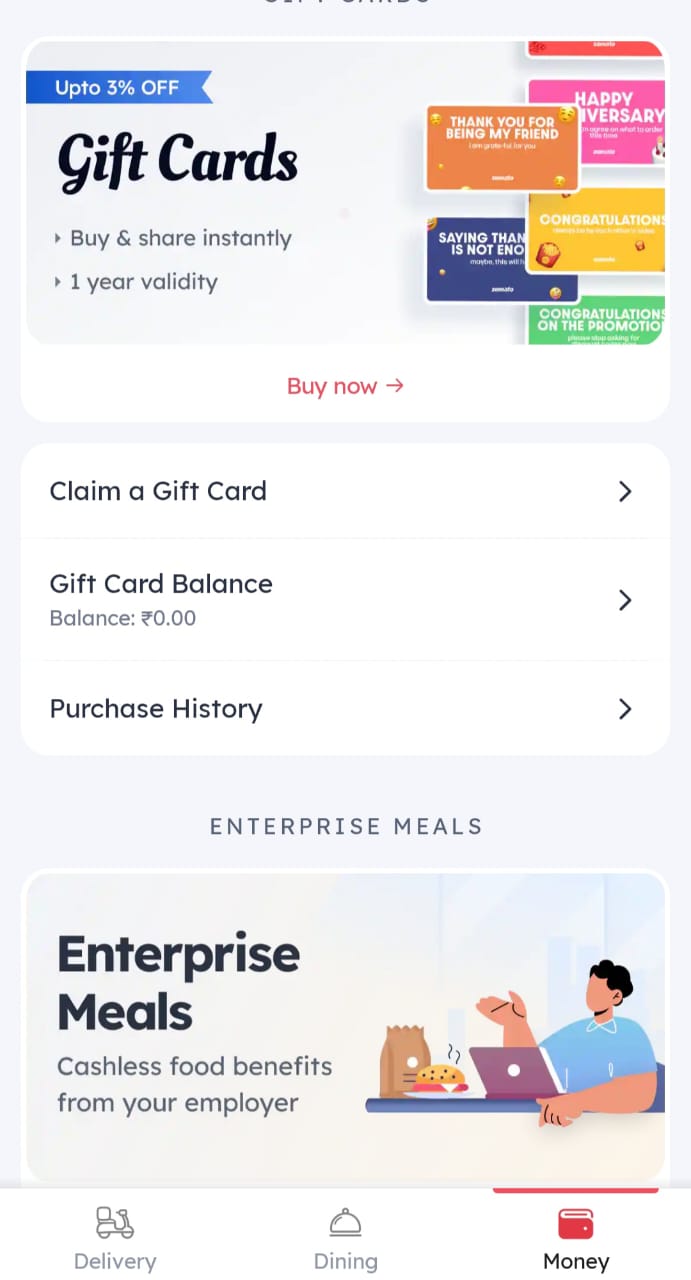
Gift Card Balance: This section would display the balance of any Zomato gift cards or vouchers that you have added to your account. Users can use these gift card balances to pay for orders on the platform.
Zomato Credits: Zomato Credits are a form of virtual currency that users can earn through promotions, referrals, or other activities on the platform. This section would show your Zomato Credits balance, which you can use to get discounts on your orders.
Gift Cards: This section might allow you to purchase Zomato gift cards to give as presents to others. You could select the value of the gift card and send it to the recipient.
Offers on Purchase: If there are any ongoing promotions or discounts related to purchasing Zomato gift cards, this section might provide details on those offers.
Purchase History: This feature would display a history of your transactions related to gift card purchases, adding credits, and using them for orders. It can help you keep track of your financial activity on the platform.
Profile
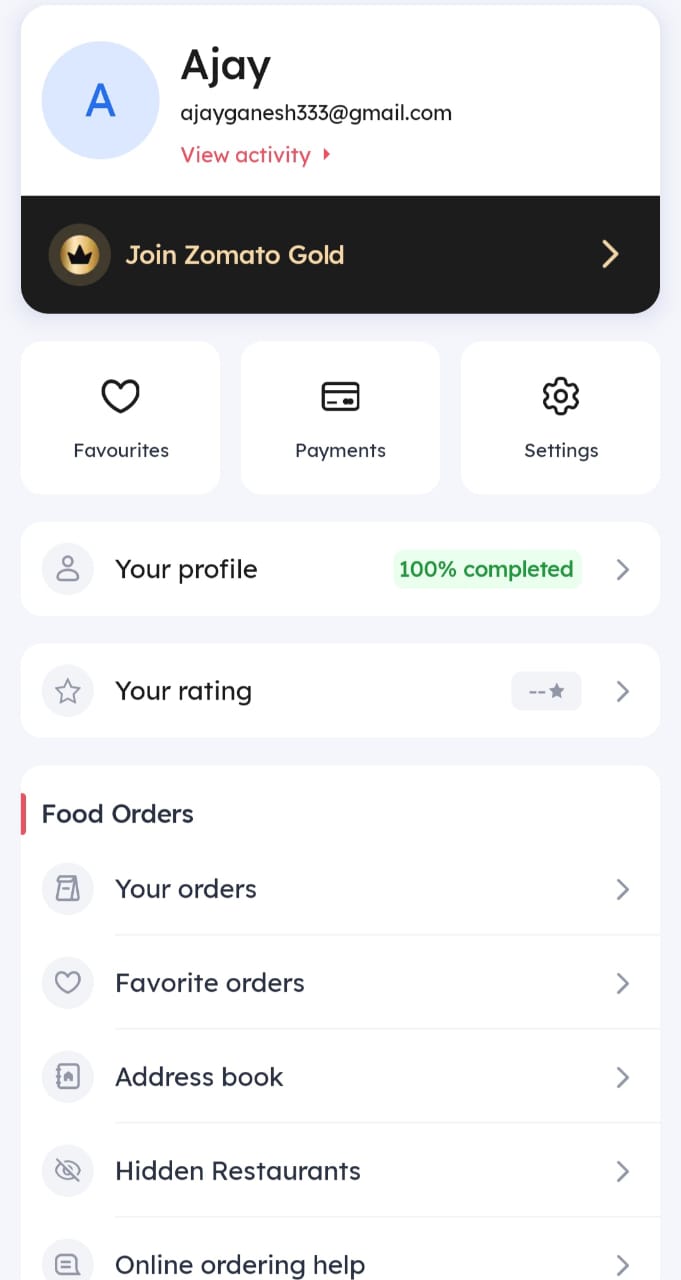
Zomato Gold: Zomato Gold is a subscription service that offers benefits such as discounts at partner restaurants and exclusive access to events. In the "Profile" section, you can manage your Zomato Gold membership.
Favorites: In this section, you can save your favorite restaurants and dishes for quick access and future orders.
Payments: Manage your payment methods, including credit/debit cards and digital wallets. You can add, edit, or remove payment options here.
Settings: Customize your app preferences, including notification settings, language preferences, and account security settings.
Your Profile: View and edit your personal information, including your name, email address, and contact details. You may also upload a profile picture here.
Food Orders: Access a history of your past food orders. You can review details of previous orders, including order status and items ordered.
Your Ratings: See a list of restaurants you've rated and reviewed. You can also edit or delete your ratings and reviews here.
Your Orders: This section provides an overview of your current and past orders, including order details, delivery tracking, and order status.
Favorite Orders: Save your frequently ordered items as favorite orders for quick reordering.
 Address: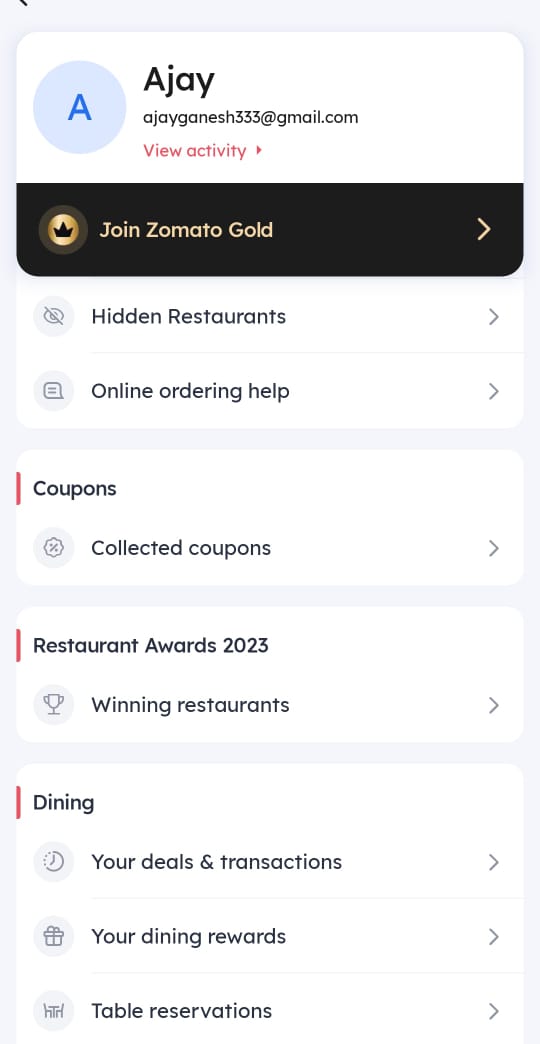
Manage your delivery addresses, including adding new addresses or editing existing ones.
Hidden Restaurants: If Zomato offers a feature to hide certain restaurants or cuisines from your search results, you can manage these preferences here.
Online Ordering Help: Access resources and support for online ordering-related queries and issues.
Collected Coupons: View and manage any coupons or discounts you have collected or applied to your orders.
Winning Restaurants: If Zomato runs contests or promotions related to dining at specific restaurants, you can find information about winning restaurants and rewards here.
Your Deals and Transactions: Keep track of any deals or promotions you've availed of and review your transaction history.
Your Dining Rewards: If Zomato offers dining rewards or loyalty programs, you can manage your rewards and check your progress in this section.
Table Reservations: If Zomato offers table reservations at restaurants, you can manage your reservations and view upcoming bookings in this section.
Dining Help: Access resources and support for dining-related queries and assistance.
Table Reservation Help: Get information and support for any issues or questions related to table reservations.
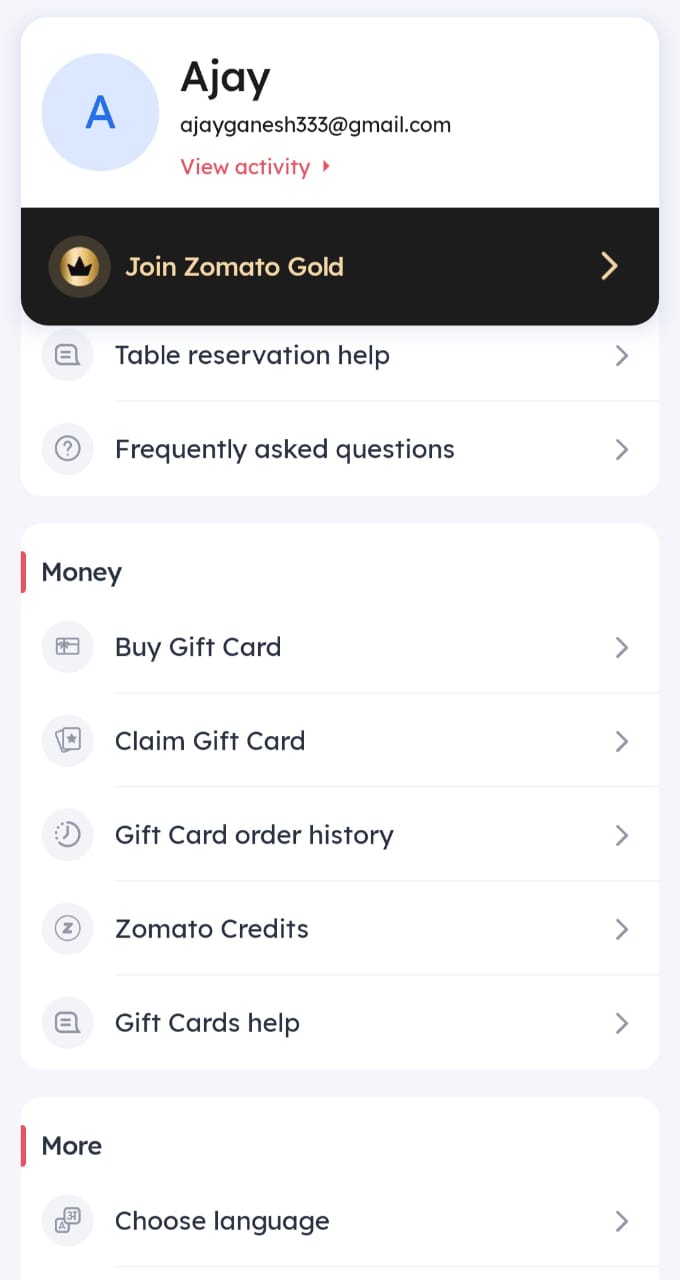
Frequently Asked Questions: Find answers to common questions and doubts about using the Zomato app and services.
Money: This section may display your Zomato wallet balance or any financial information related to your account.
Buy Gift Card: Users can purchase Zomato gift cards to gift to others or for personal use. These gift cards can be redeemed for food orders.
Claim Gift Card: If you have received a Zomato gift card, you can claim it in this section to add the card's value to your Zomato account.
Gift Card History: View a history of the Zomato gift cards you've purchased or claimed, including details like the card's value and redemption status.
Zomato Credits: Zomato Credits are virtual currency earned through promotions or referrals. In this section, you can manage your Zomato Credits and see how they can be used.
Gift Cards Help: Access resources and support for issues related to Zomato gift cards, such as how to purchase, redeem, or troubleshoot gift card-related problems.
More: This could be a submenu with additional options or settings related to your Zomato account.
Choose Language: Customize the language in which you want to use the Zomato app.
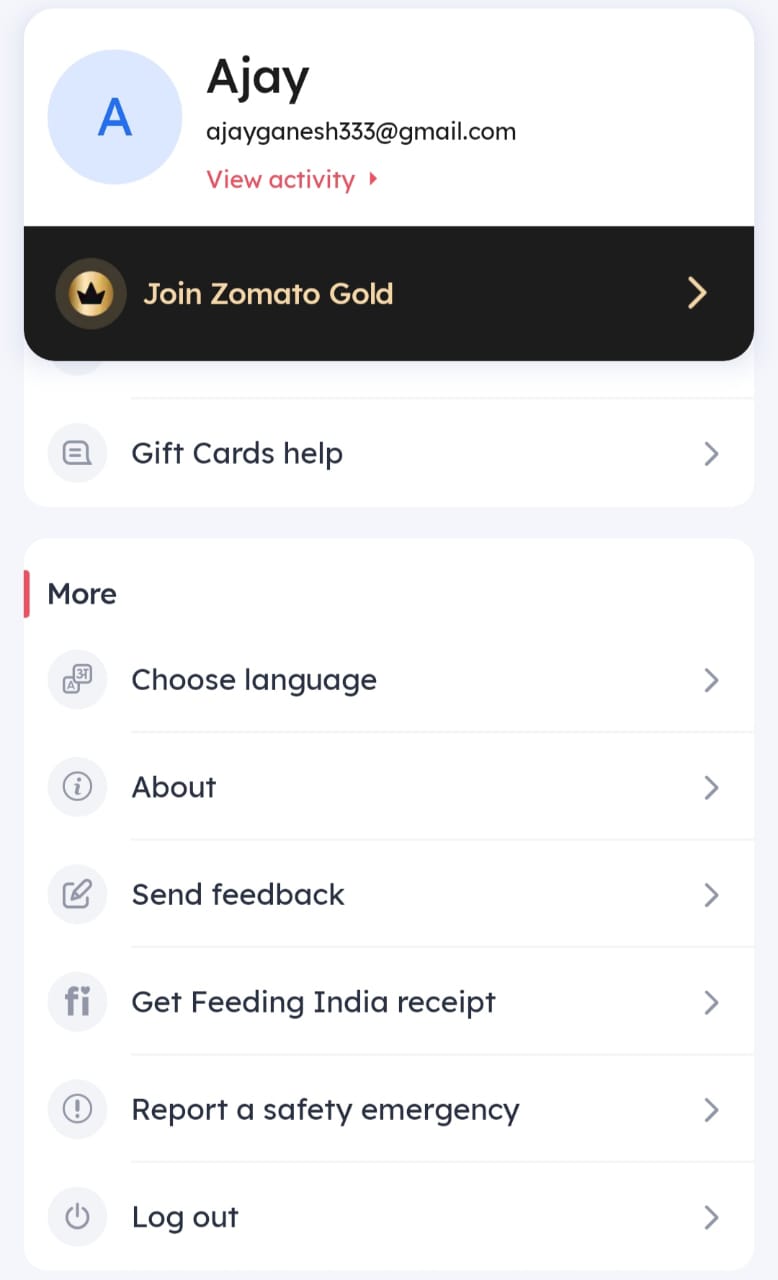 About: Access information about the Zomato app, including version details and legal information.
Send Feedback: Provide feedback to Zomato about your app experience, including suggestions or issues you've encountered.
Get Feeding Receipt: If Zomato offers digital receipts for your orders, you can access them in this section.
Report a Safety Emergency: If you encounter any safety-related issues during your food delivery or dining experience, you can use this feature to report emergencies.
Logout: Log out of your Zomato account for security or switching to another account.
Zomato Riders
The Zomato Riders app has several features that cater to the needs of delivery personnel (riders) working for the food delivery platform. These features are designed to enhance efficiency, incentivize performance, and ensure the riders' well-being. Here's an overview of the key features:
1. Order Tracking: Riders can use the app to receive and track orders in real-time. They can view the order details, delivery location, and customer contact information.
2. Earnings and Rewards:
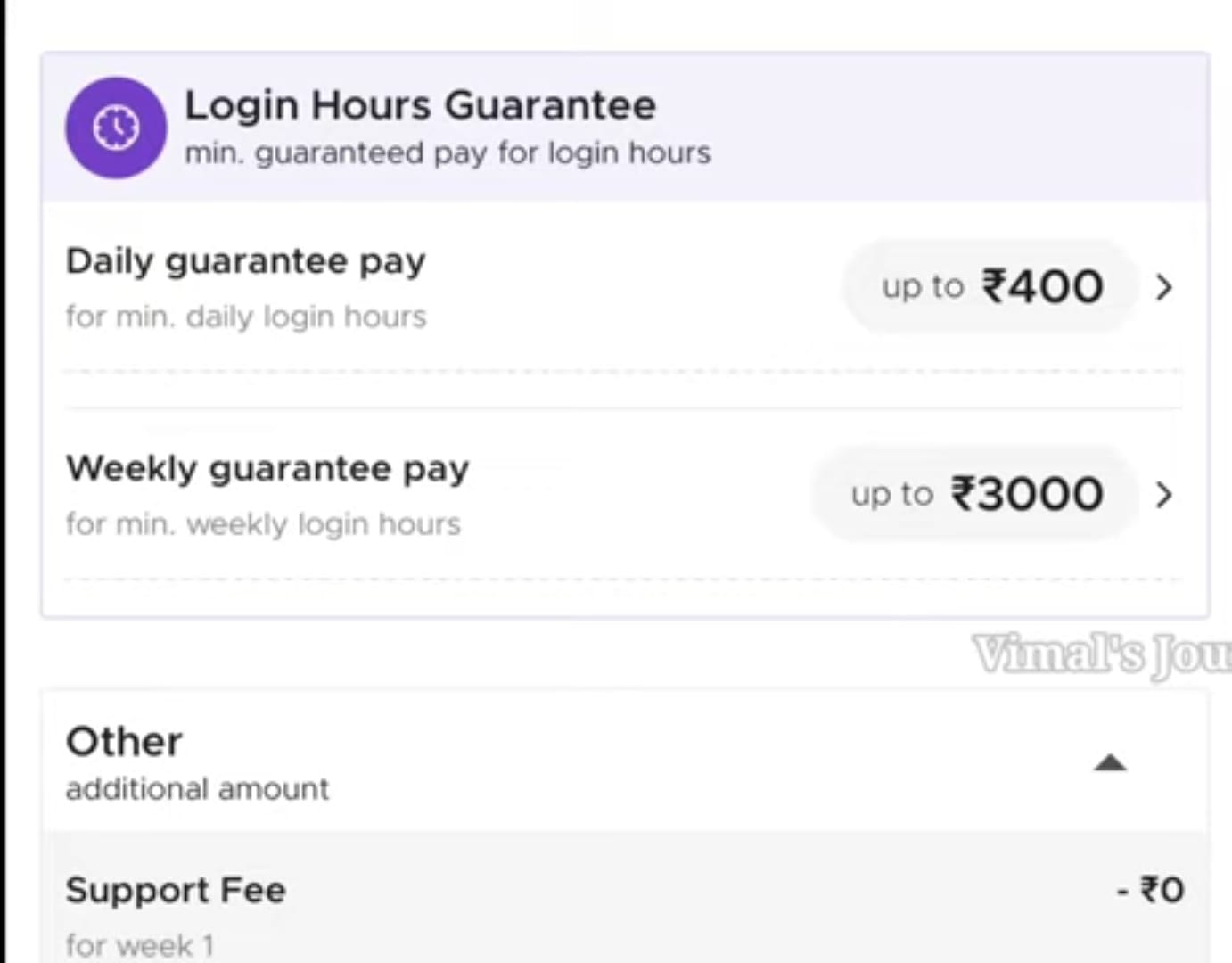
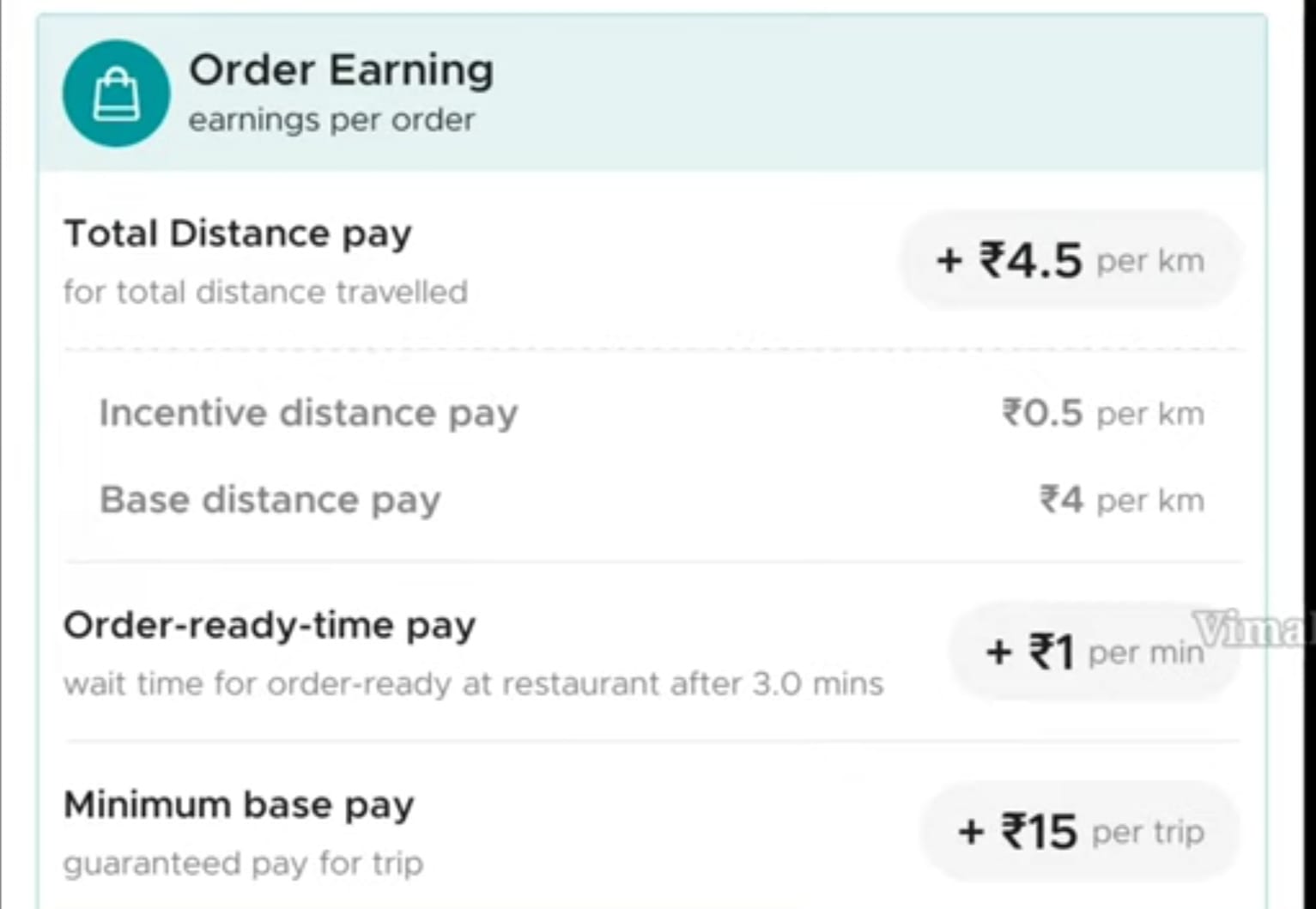
Earnings Per Kilometer: Zomato riders are rewarded based on the number of kilometers they travel. For every kilometer they ride or drive, they earn Rs. 13, which is their basic rate per kilometer.
Higher Earnings than Swiggy: Zomato claims to pay its riders more than its competitors, such as Swiggy. This is an attractive feature for riders looking to maximize their earnings.
3. Flexibility:
No Fixed Shifts: Unlike some other delivery services like Swiggy, Zomato riders enjoy more flexibility in terms of their working hours. They are not bound by fixed shifts and can choose when they want to work.
4. Gigs:
The mention of "gigs" suggests that Zomato might offer additional opportunities or special assignments to riders. These could include promotions or temporary gigs that offer extra incentives and rewards.
5. Performance-Based Rewards and Incentives:
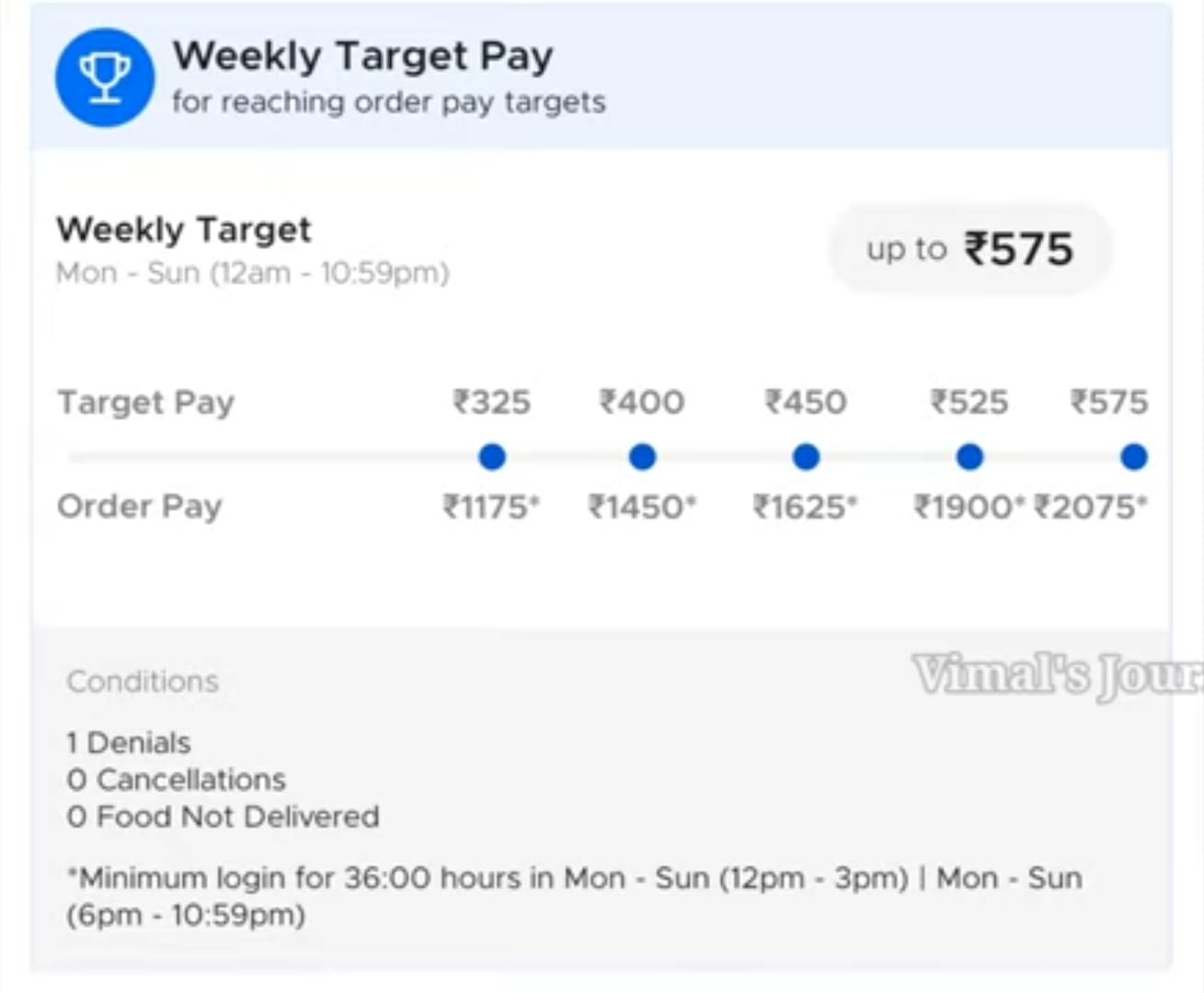
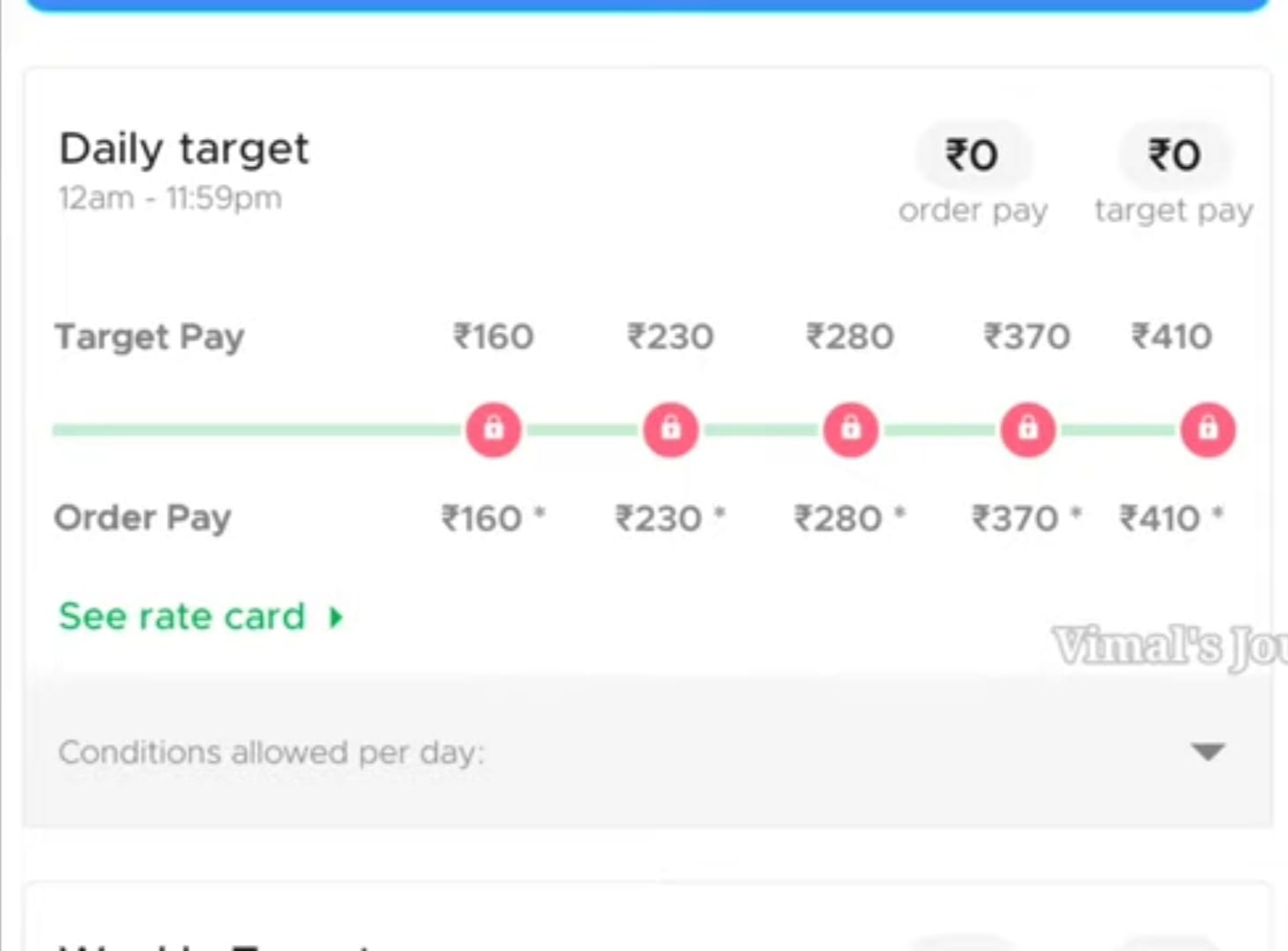
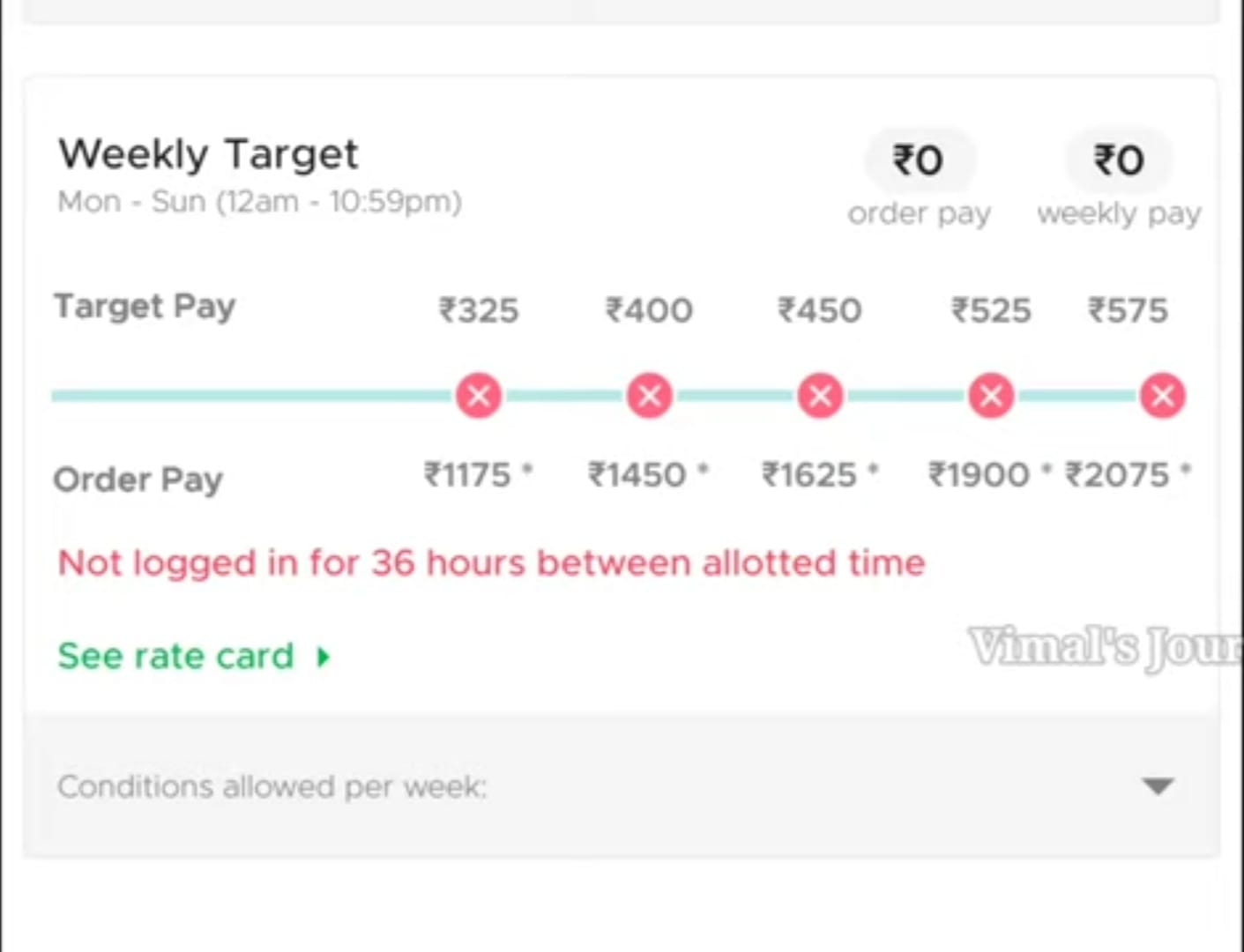
Zomato provides performance-based rewards and incentives to motivate its riders to excel in their job. These incentives could include bonuses, extra payments for completing a certain number of deliveries, or reaching specific targets.
6. Earning Potential:
The mention of riders potentially earning up to Rs. 60,000 if they work 12 hours regularly for 30 days implies that Zomato provides riders with the opportunity to maximize their earnings through consistent, dedicated work.
7. Order Statistics:
The app likely provides riders with statistics on the number of orders they've taken per day, per week, and per month. This feature helps riders keep track of their performance and earnings over time.
8. User-Friendly Interface:
The app is likely designed with a user-friendly interface to make it easy for riders to navigate, accept orders, and manage their work efficiently.
9. Safety Features:
The app may include safety features, such as emergency contact options, real-time support, and guidelines for safe riding and food delivery.
The Zomato Riders app aims to empower its delivery personnel with tools and incentives to enhance their earnings, ensure flexibility in working hours, and provide a competitive advantage over other food delivery platforms. Riders can use the app to maximize their potential earnings while enjoying a more flexible working schedule compared to other platforms.
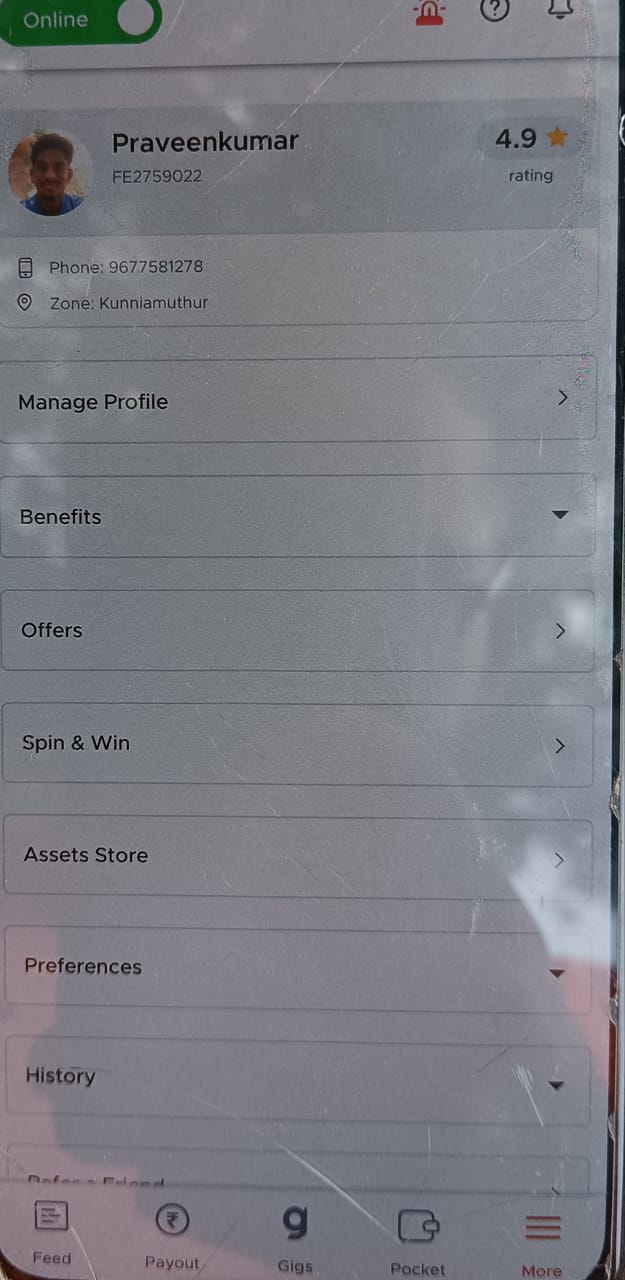
In the Zomato Riders app, the user profile contains several sections, each with its own purpose. Here's an explanation of each of the sections you mentioned:
1. Manage Profile:
Allows riders to update their personal information, contact details, and other profile-related settings.
2. Benefits:
Provides information about the advantages and perks that riders can enjoy while working for Zomato. This may include details about discounts, rewards, and special offers for riders.
3. Offers:
Riders can browse and access various promotional offers and discounts, which may be exclusive to Zomato riders. These offers can help riders save money and enhance their earnings.
4. Spin and Win:
A gamified feature where riders can participate in a virtual game or activity to win rewards. This can include discounts, bonuses, or other incentives to make the experience more engaging.
5. Asset Store:
This section may allow riders to purchase or acquire digital assets, such as equipment, accessories, or other items to support their delivery work. For instance, it could include information on where to obtain branded gear.
6. Preferences:
Allows riders to set their personal preferences, such as preferred delivery zones, working hours, or vehicle type, to customize their experience on the platform.
7. History:
Provides a record of the rider's past activities and transactions, including order history, delivery records, and payment history. This is useful for tracking work history and earnings.
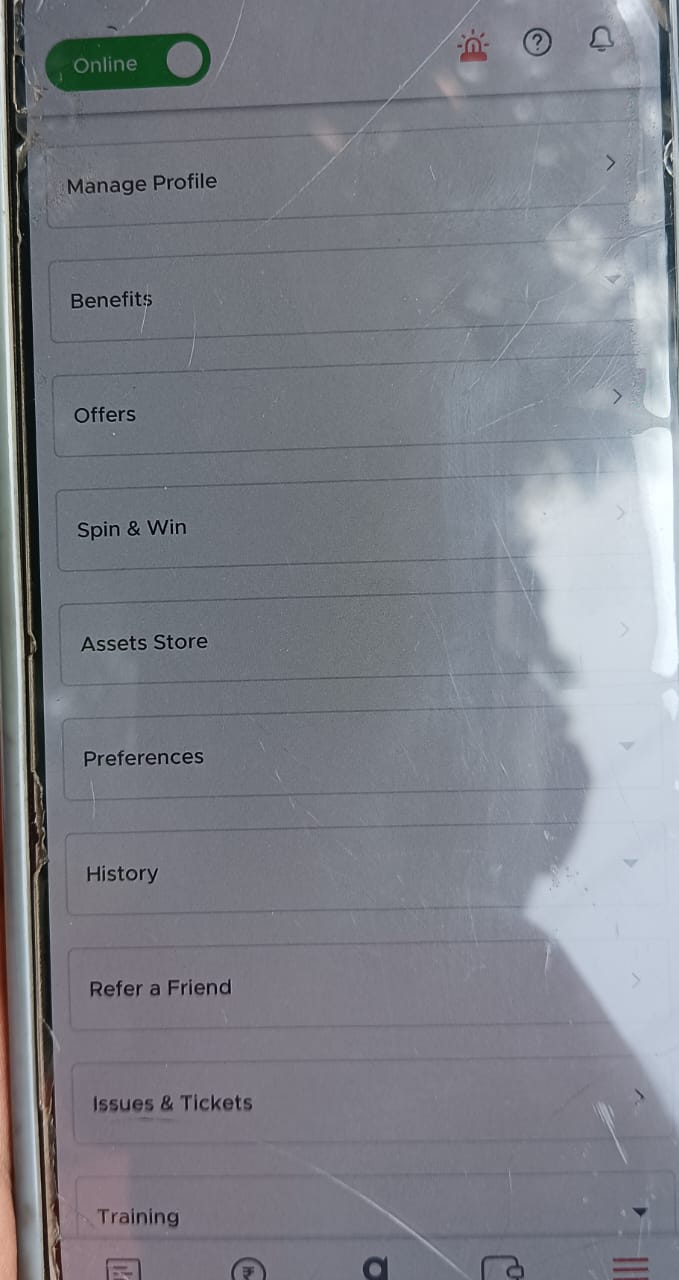
8. Refer a Friend:
This feature enables riders to refer new riders to join the platform. When the referred friends sign up and start delivering for Zomato, the referring rider may earn rewards or bonuses as an incentive.
9. Issues and Tickets:
Allows riders to report problems, issues, or incidents they encounter during their deliveries. Zomato support can then address these concerns and resolve them. This section is crucial for addressing any operational or service-related issues.
10. Training and Help:
Provides access to resources, guides, and training materials for riders. It may include information on safe riding practices, customer service guidelines, and troubleshooting common delivery-related problems. It's a valuable resource for improving rider performance and service quality.
These sections collectively make the Zomato Riders app a comprehensive tool for riders to manage their profiles, access benefits and offers, track their performance, and seek assistance when needed. The app aims to enhance the overall experience for riders, making their work more efficient and rewarding.
1. Feed Page:
The "Feed" page in the Zomato Riders app is likely a dynamic information hub where riders can access important updates, announcements, and news relevant to their work. It may include notifications about changes in company policies, special promotions, new features, or reminders for important events. This page helps riders stay informed about the latest developments in their role as delivery personnel.
2. Payout Page:
The "Payout" page is where riders can view and manage their earnings. It provides a breakdown of their earnings, showing the amount they've earned for completed deliveries. This page typically includes information about the current payout cycle, details on how earnings are calculated, and options for cashing out or transferring the earnings to their bank account.
3. Gigs Page:
The "Gigs" page is likely a section where riders can access special job opportunities or assignments beyond regular food deliveries. These gigs may include promotions, seasonal work, or opportunities for additional earnings. For example, riders might be offered the chance to participate in marketing campaigns, deliver during peak hours, or take on unique tasks for extra pay.
4. Pocket Page:
The "Pocket" page is where riders can manage their finances and earnings. It may include features related to their digital wallet, bank account details for direct deposits, and options for tracking their income. Riders can use this page to keep tabs on their available balance and access information about their financial transactions.
5. More Page:
The "More" page is typically a menu that provides access to various additional features and settings within the app. It serves as a central hub for accessing functions and information that don't fit neatly into other categories. Common items found on the "More" page may include account settings, preferences, help and support options, and other resources to enhance the overall app experience.
These pages in the Zomato Riders app are designed to offer riders a comprehensive platform for managing their work, earnings, and overall experience. The "Feed" page keeps them informed, the "Payout" page helps them track their earnings, "Gigs" provides opportunities for additional income, "Pocket" manages their financial transactions, and the "More" page serves as a gateway to various other features and settings to tailor their app experience.
 Booking and Delivery:
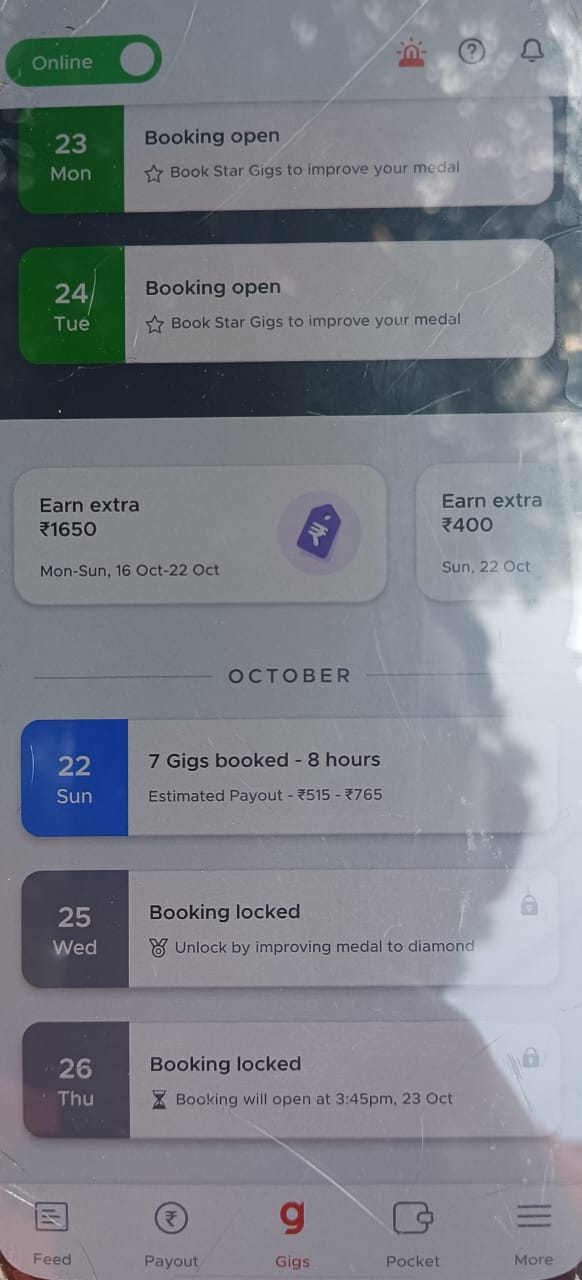
In the "Gigs" section, riders can explore various gigs that are available for them to take on. These gigs may include tasks such as delivering promotional materials, participating in marketing campaigns, catering to special events, or completing unique deliveries. Riders can choose the gig that interests them and accept it through the app.
Estimated Payout:
The "Estimated Payout" is a feature in the "Gigs" section that provides riders with information about how much they can expect to earn for completing a particular gig. This estimated payout is typically based on the complexity of the task, distance, and any special requirements associated with the gig. It helps riders make informed decisions about which gigs to accept based on their potential earnings.
What Are the Driven:
Overall, the "Gigs" section is designed to provide riders with opportunities to earn extra income by taking on various tasks or assignments beyond regular food deliveries. Riders can review the estimated payout for each gig and accept those that align with their interests and availability. This feature enhances the flexibility and earning potential for riders on the platform.
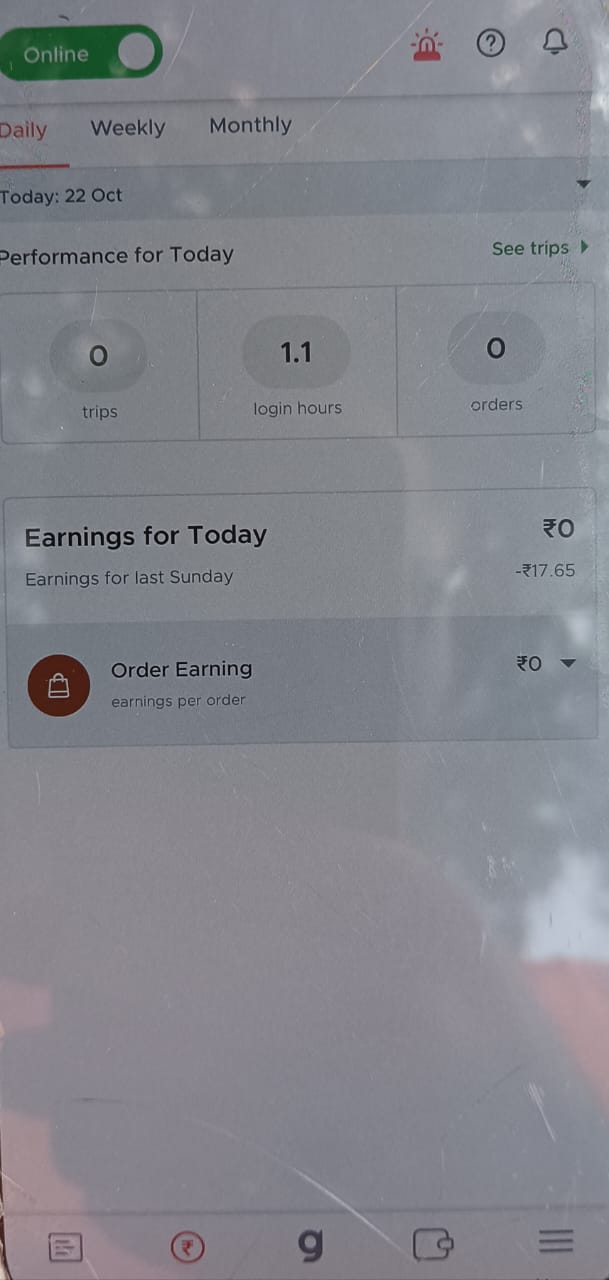
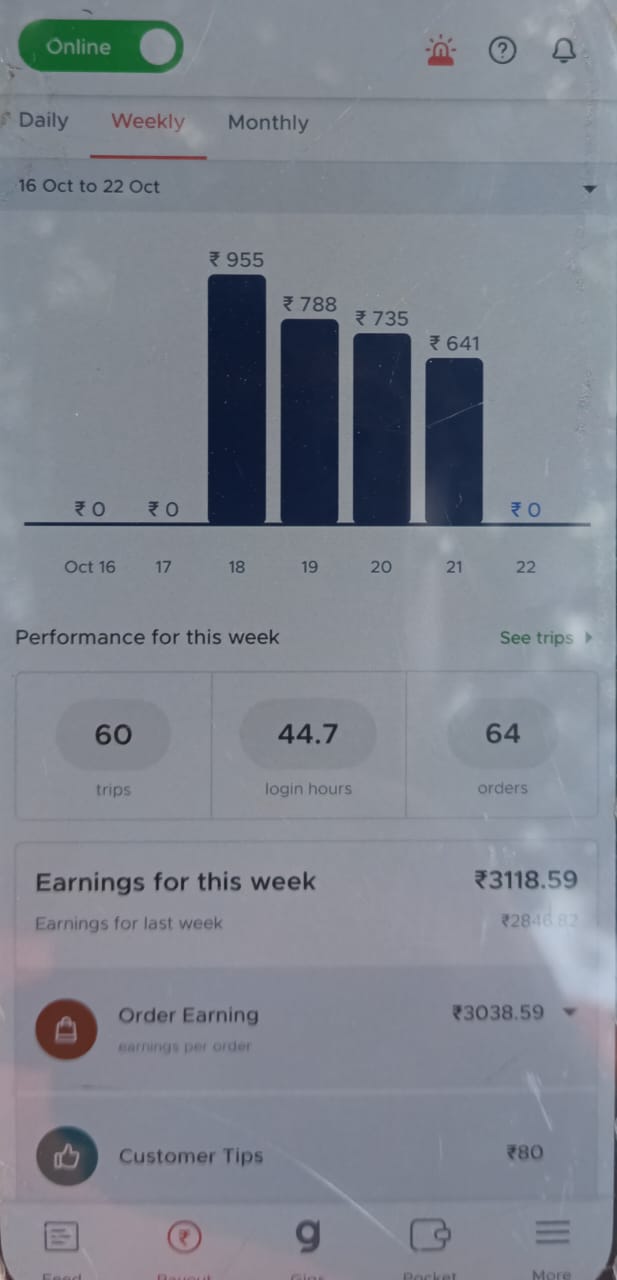
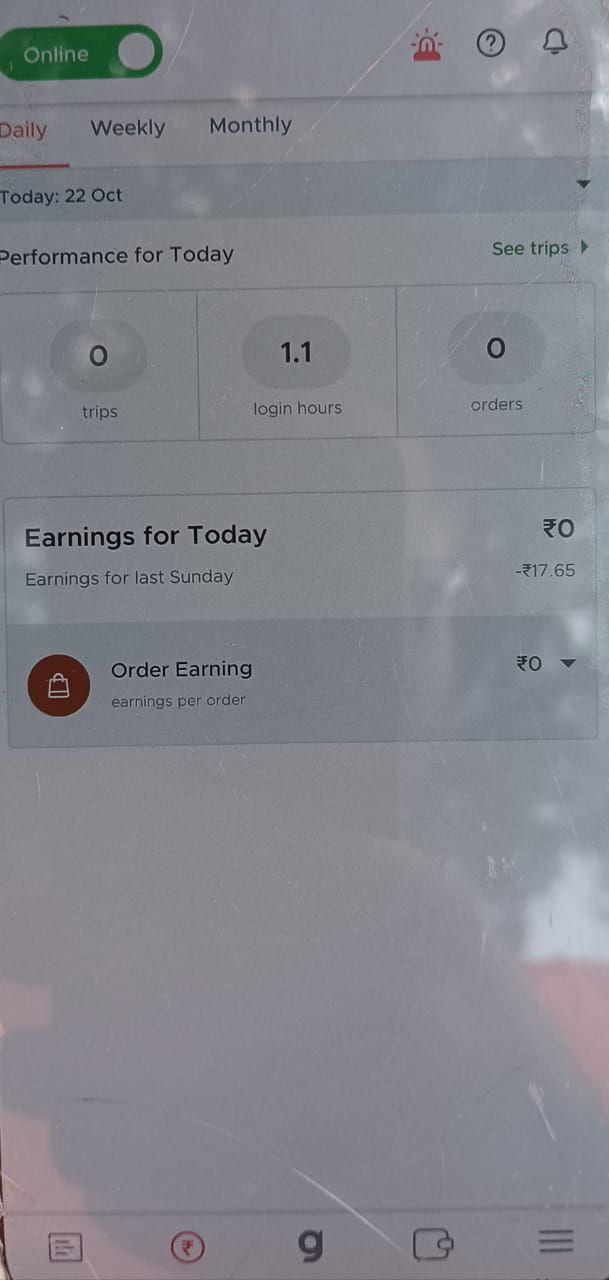
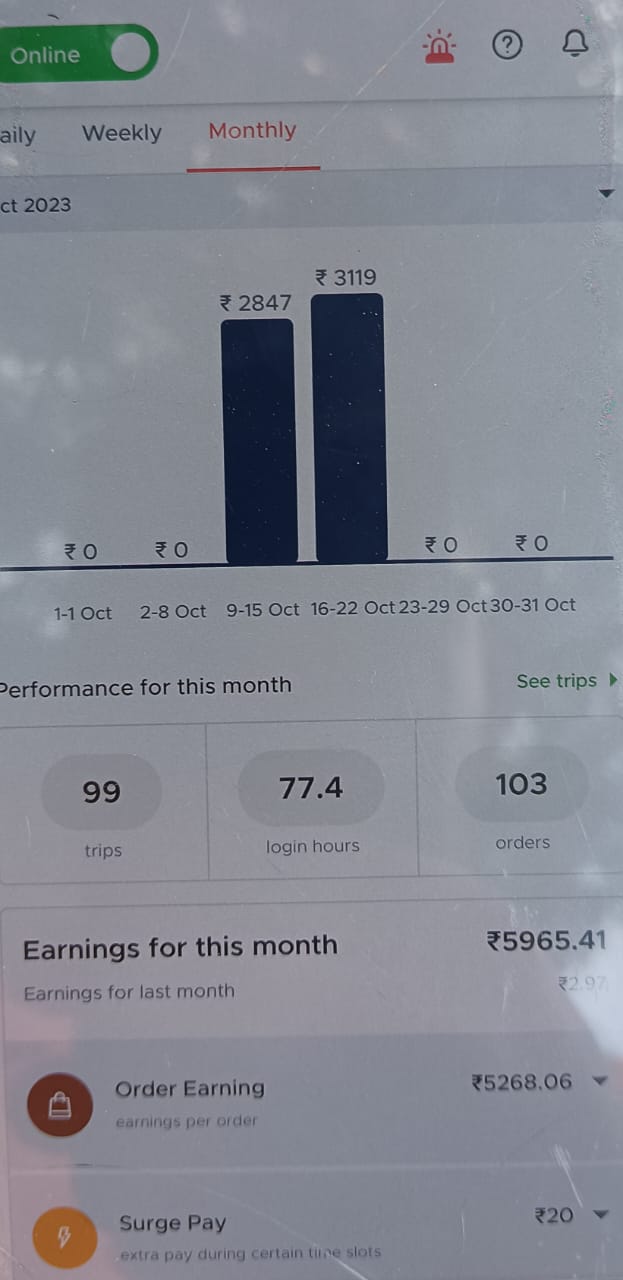
The "Payout" section in a delivery app like Zomato typically provides essential financial and performance information to riders
1. Number of Trips:
This is the count of deliveries or trips you have completed during a specific period. It helps you track your productivity and assess how busy or productive you've been during a given timeframe.
2. Login Hours:
This indicates the total number of hours you've spent logged into the app and available for deliveries. It helps you monitor your work hours and ensure that you meet any hourly or shift requirements set by the platform.
3. Orders:
This section shows the number of orders you've accepted and delivered during the day, week, or month. Tracking your order count is crucial for understanding your workload and assessing your efficiency.
4. Earnings:
This displays the total earnings you've made for the selected time frame (day, week, or month). It includes your base earnings, incentives, tips, and any other sources of income. Knowing your earnings is essential for financial planning.
5. Performance Graph:
The performance graph is a visual representation of your work performance over time. It typically plots metrics like order completion rate, on-time delivery rate, and customer ratings. It helps you assess your consistency and identify areas where you may need to improve.
The "Payout" section is a critical tool for riders as it allows them to track their work metrics, earnings, and performance. It helps riders stay informed about their progress, make data-driven decisions about their work, and ultimately manage their finances and work hours more effectively.
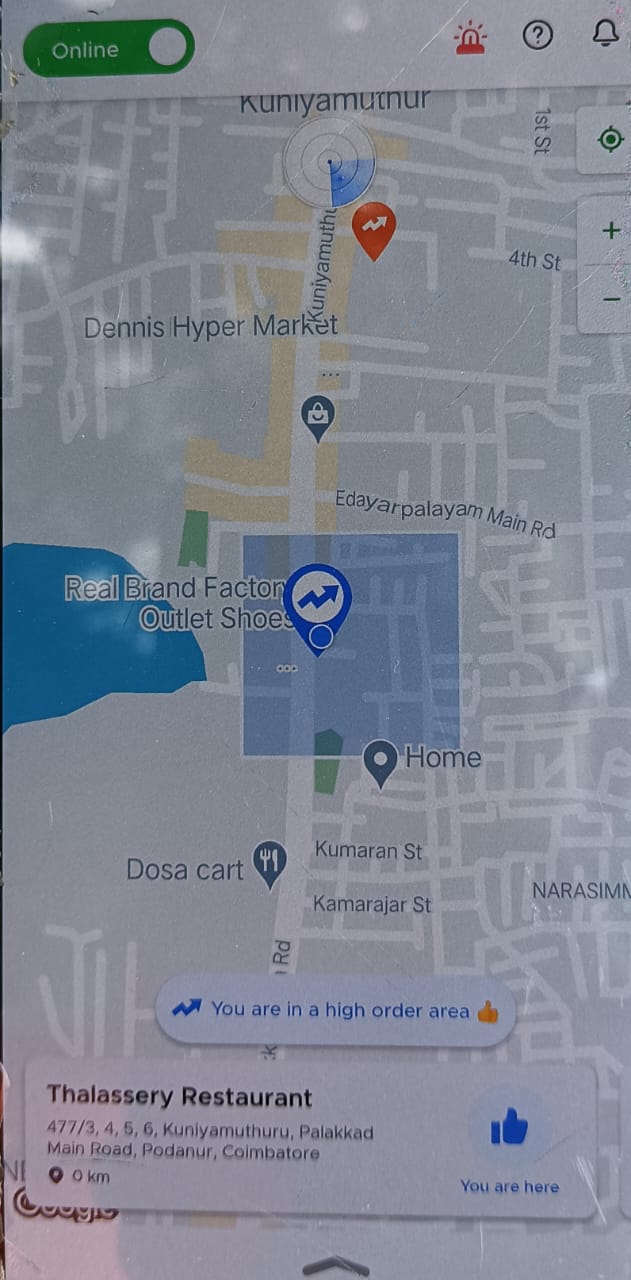
The map that displays high-order areas in a delivery app, where you are one among the riders in your designated zone, is a tool designed to provide you with essential information and optimize your delivery activities. Here's an explanation of how this works:
1. High-Order Area:
A high-order area is a location or region where there is a significant demand for food delivery orders. These areas are usually busy and have a high concentration of potential customers. The reasons for high order volume can vary, such as densely populated neighborhoods, commercial districts, or areas with many restaurants.
2. Your Zone:
- In the context of a delivery app, a "zone" typically refers to a specific geographic area that has been assigned to a group of delivery riders. Each rider is responsible for delivering orders within their designated zone. The division of zones helps optimize the delivery process, ensuring that each area is adequately covered by riders.
Here's how this system benefits both the delivery platform and the riders:
Efficient Distribution: By dividing the service area into zones, the delivery platform can efficiently distribute orders to the nearest available riders. This reduces delivery times and ensures that orders reach customers promptly.
Rider Optimization: Riders are assigned to zones to ensure that there is a balanced distribution of delivery personnel across high-order areas. This means that you, as a rider, are working in an area with a high potential for earning money due to the volume of orders.
Increased Earnings: When you are working in a high-order area within your zone, you have a higher likelihood of receiving frequent orders. This can lead to increased earnings as you have a steady flow of deliveries to make.
Better Customer Experience: Customers in high-order areas benefit from quicker deliveries, resulting in a better overall experience. Satisfied customers are more likely to use the service again and leave positive reviews.
Data-Driven Decision-Making: The app uses data and algorithms to identify high-order areas. This data-driven approach ensures that the platform can allocate resources effectively and adapt to changing customer demand patterns.
Competitive Advantage: Riders in high-order areas can earn more than those in less busy zones, making it a competitive advantage for delivery personnel working in such locations.
In summary, the map displaying high-order areas and assigning you to a specific zone is a part of the logistics and optimization system used by delivery platforms to ensure timely and efficient order deliveries. This benefits both riders and customers by reducing delivery times, increasing earning potential, and enhancing the overall service quality.
Incentives
Performance Metrics: Incentives are often tied to performance metrics such as order completion rate, on-time deliveries, and customer ratings. Drivers who consistently meet or exceed these metrics may receive higher incentives.
Peak Hours: As you mentioned, certain times of the day, such as evening hours between 6 to 10, are often considered peak hours for food delivery. Drivers who work during these times may receive higher incentives due to increased order volume and demand.
Cancellation and Non-Delivery: To encourage reliability, incentives may be affected by the number of order cancellations and instances where the food is not delivered. Drivers with a lower rate of cancellations and non-deliveries may receive better incentives.
Order Volume: Incentives can be influenced by the number of orders a driver completes within a specific time frame. The more orders a driver delivers, the higher their potential incentives.
Distance Traveled: Drivers may also be rewarded based on the total kilometers driven. Longer-distance deliveries may come with higher incentives to compensate for the additional time and fuel costs.
Region-Specific Factors: The incentives can vary from one region to another due to differences in market dynamics, competition, and customer demand. In regions with more competition or higher demand, incentives might be more attractive to attract and retain drivers.
Special Promotions: Food delivery platforms often run special promotions, discounts, or bonuses during certain periods or for specific events. Drivers who participate in these promotions may earn extra incentives.
It's important to note that the exact details of these incentives can change frequently, and they are typically communicated to the drivers by the platform through their app or other means. Drivers should regularly check the terms and conditions to understand the current incentive structure in their area.